

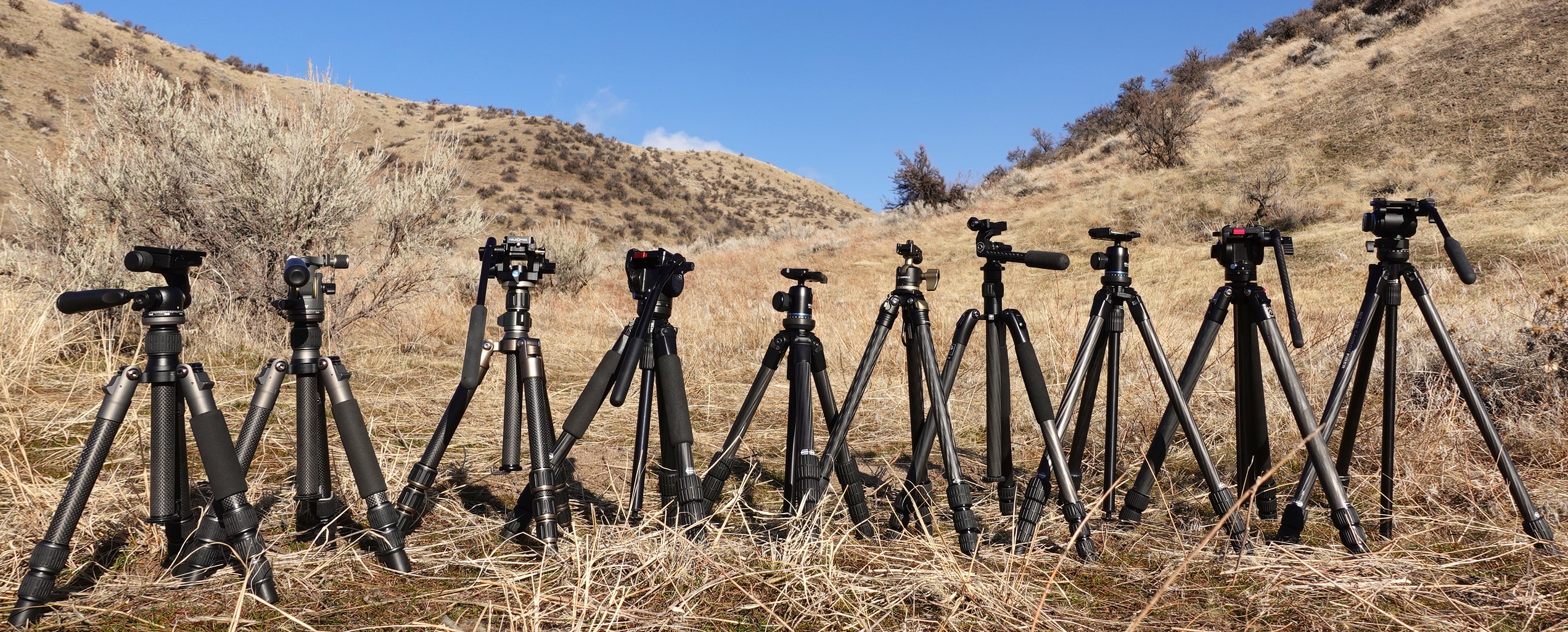
Looking for the best ultralight tripod for your outdoor adventure? What is the best ultralight tripod for hunting and backpacking? What features are important, and what features are negotiable? The world of ultralight tripods has a ton of options, but for this review we have narrowed it down to the two pound weight class. Personally, I need an ultralight tripod that can be used for glassing with binoculars and is stable enough to throw a spotting scope on too if needed, and possibly even do some filming off of it, all while being as light as possible. Easy enough, right?
Unfortunately, it’s just not that simple. There is much give and take with ultralight tripods as you typically give up stability in exchange for weight savings and compact size.
**UPDATED FEBRUARY 2026**
For this review, we had to narrow down our own selection because there are SO MANY tripods on the market these days. It was tough, but we wanted to find a tripod that meets all of the following:
- Carbon fiber
- Ultralight (around 2 pounds and under – tripod only)
- Able to hold binoculars, a spotting scope, and possibly even shoot off from
- Built for the backcountry
- Has extendable center column
While each of those features are not particularly difficult to find in a tripod, tripods that meet all of those requirements or most of them is not so easy, so we set out to test 10 options that appeared to meet these requirements and took them into the field over the last year.
Factors When Selecting An Ultralight Tripod
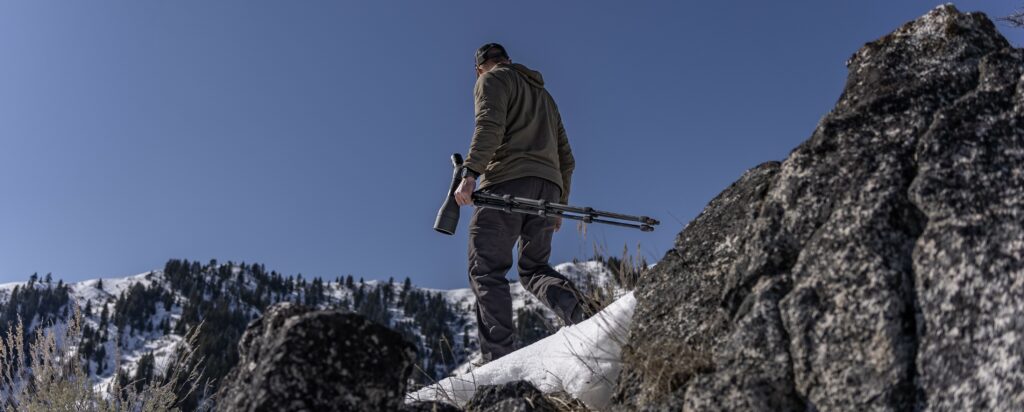
There are a number of very important factors that come into play when you are trying to decide what ultralight tripod is going to work best for your specific needs. Each person may have a slightly different priority list, so it’s important to identify what your essentials are in a tripod. It’s easy to get off in the weeds, so stick to what you truly need in a tripod, and narrow it down from there.
Some factors to think through might be:
- Primary uses
- Weight
- Do I need it to hold a spotting scope or just binoculars?
- Do I need to be able to shoot off it?
- What minimum height do I need?
- What maximum height do I need?
- Does it need to be compact?
Make sure to check out our other gear reviews and the Backwoods Pursuit YouTube Channel to help you decide what gear will help you stay out in the field longer!
PRIMARY USES
The number one question you need to start with when selecting a tripod is, What will it’s primary use be? This will drive your selection process as you wade through the many options, designs, and features available in a tripod.
WEIGHT
Typically, the most exclusive feature tends to be the weight. If weight is no issue, it opens up literally hundreds of other options, but given that we wanted a tripod that starts at around 2 pounds, that narrows the field down to a very small selection. Next in priority, we needed a tripod that could adequately handle binoculars as well as a small spotting scope, but preferably able to do a decent job with a larger spotting scope when needed. This is counter intuitive because to get the stability needed to handle a large spotting scope like the Kowa TSN 88A we were testing with these, you typically need a much more robust tripod.
MINIMUM AND MAXIMUM HEIGHT
You’ll also run into significant limitations in the maximum height when you are looking at the 2 pounds and under tripod class, but ideally it’s nice to have the ability to at least glass with binoculars while standing up. This is far from a “top of the list” feature, but it’s nice to have.
HOW MANY LEG SECTIONS?
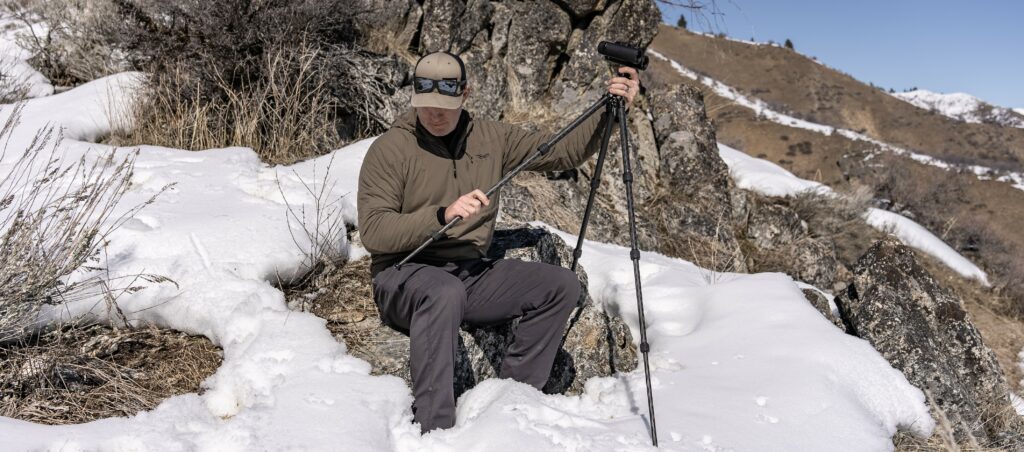
One factor not typically thought of in selecting a tripod is the number of leg sections. The typical tradeoff is that if you want a more compact tripod, you are going to have either 4 or 5 leg sections. Why is that a big deal? Well, in my personal experience, the more leg sections you have, the less stable the tripod, and the more inconvenience it is to set up. Every additional leg sections means you’ll have to loosen and then tighten 3 additional joints (one for each leg). This can get annoying, but it also gives you additional versatility and adjustability. Both are considerations.
NEED TO SHOOT OFF IT?
Finally, I personally want a tripod that I can shoot off of when I’m rifle hunting. I’ve set up all my rifles with a Salmon River Solutions Arca+Picatinni Rail direct attachment system so I can lock my rifle to the tripod and have a steady shooting platform. This has been a game changing setup, so it’s a must for me. Unfortunately, from a weight standpoint, you typically need a more substantial tripod to handle the weight and recoil of a rifle, so this adds to the problem of wanting an ultralight tripod for the backcountry.
I think we found some pretty sweet options, though, so let’s dive into the 10 best ultralight tripods we tested.
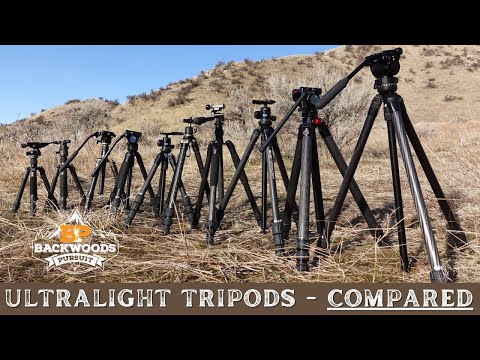
See These Tripods In Video!
Selecting A Tripod Head
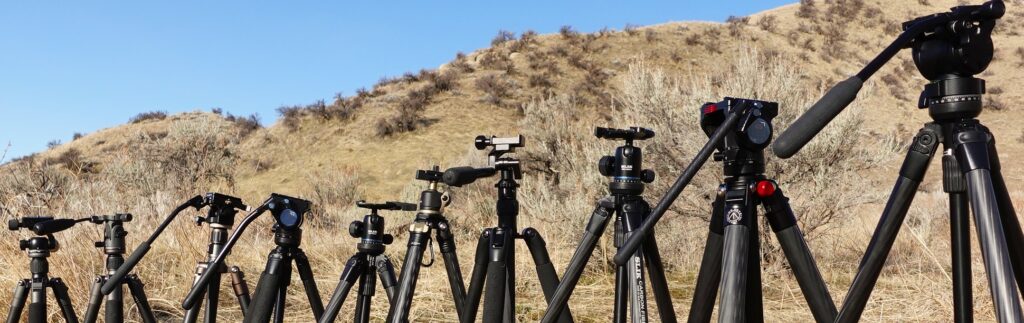
Now for a quick word on selecting a tripod head. While tripod heads are a review all on their own, we used the same heads when testing all of the tripods below. Each head was rotated from tripod to tripod. What style of tripod head you need depends on a lot of things, but like tripods, generally you will need a heavier more robust tripod head to support a spotting scope or a rifle if you want to shoot off a tripod than if you just want to use it for binoculars. The ones we used in this testing were:
- Sirui VA5
- Wiser Precision Nighthawk
- Slik SBH-400
- Field Optics ULP
- Field Optics FVH-300
- Tricer LP Pan Head
- Aziak Vantage Pan Head
- MTN Hunter Nano Pro Fluid Head
- Outdoorsman Micro Pan Head
- Outdoorsman Pan Head
A couple of the tripods had a head included, so if that was the case we tested that head as well as these other heads on the tripods. Our personal favorites of the ultralight tripod heads was the Tricer LP, the Aziak Vantage Pan Head, and Wiser Precision Nighthawk, while our personal favorite of the heavier video heads was the Sirui VA5.
Now, let’s dive into the tripods.
MTN Hunter SS Tripod Review
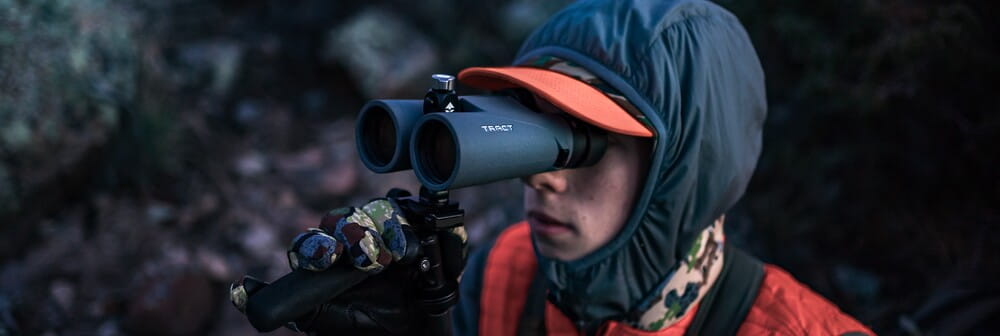
The MTN HNTR SS tripod is a great place to start as it is one of the lightest weight tripods you can get, that still functions as a tripod that will handle both binoculars, spotting scopes and even cameras. This is a sitting height ultralight tripod, with it’s generous 47 inch max height. Pair that height with an incredible weight of just 21 ounces, and you have one of the lightest, most packable ultralight tripods out there that still gives you good usable height in steep mountain terrain.
If you add in the MTN HNTR Nano Pro fluid head, at just 10 ounces with the included ARCA plate (8 ounces without), you have an insanely good backcountry tripod weighing in at less than 2 pounds. If you pick up the Tricer LP pan head (4 oz), or the Aziak Vantage pan head (6.4 oz), you’ll reduce that total weight even more.
MTN HNTR SS TRIPOD SPECS
- Tripod only weight: 21 oz
- Tripod and Nono Pro head weight: 31 oz
- Max Height: 47 inches
- Min Height: 15 inches
- Packed size: 18.6 inches
- Leg sections: 2
- Price (tripod only): $259.95
- Price (tripod & head): $379.90
OUR TESTING AND EXPERIENCE
The specs are more than impressive on this ultralight tripod, and we found it to be not just adequate, but do really well overall. While the stance was narrow on the previous model, MTN HNTR recently updated this tripod and widened the stance by 2 inches, which made a huge difference. For such an ultralight tripod, this thing is very stable.
It easily handled the Tract Toric 80mm spotting scope, as well as the Tract Toric 65mm spotting scope we used it on during our recent Colorado hunt, and did it well. As you’d expect, extending the center column significantly reduced stability, so it’s wise to use as little of the center column as you can with any ultralight tripod.
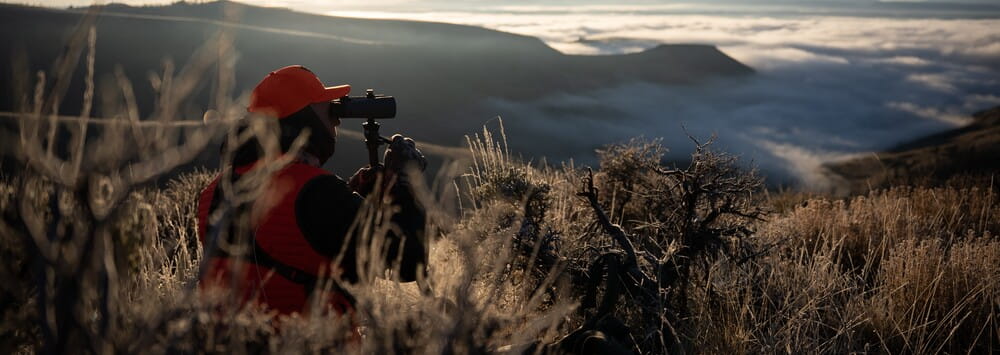
The 47 inch height was more than enough as a sitting tripod, and it afforded plenty of adjustment on steep inclines or the get over moderately tall brush. While stability significantly decreased if the center column was run up all the way, that’s to be expected and we only used it with binoculars with the center column fully extended.
WHAT WE LIKED
- Extremely lightweight
- Tall for it’s weight
- Quick deployment (2 leg sections)
- Surprisingly nice pan head (for the money)
WHAT WE DIDN’T LIKE
- Longer folded lenth
- Could be more compact when folded (diameter)
- Affected by wind
Overall we really liked the MTN HNTR SS tripod, and it’s one that is tough to leave home when you are aiming to save weight. While it’s certainly not the most stable tripod on the market, particularly when the longer center column is used, it is still more than stable enough for just about all of your use cases during backcountry hunting. We found that windy conditions, introducted significant shake, but nothing you wouldn’t expect from a tripod in the wieght class.
Aziak Backcountry Lite Tripod Review
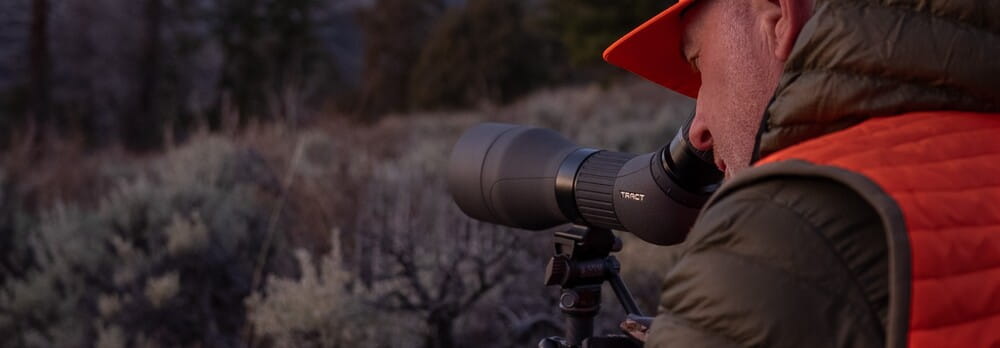
The Aziak Backcountry Lite tripod hits every mark when an ultralight backcountry tripod is what you are looking for. Better yet, when paired with the Aziak Vantage pan head, you have a dream setup weighing in at a ridiculous 26.8 ounces. The tripod alone comes in at 20.6 ounces, while the Vangatage pan head weighs in at just 6.4 ounces. Neither of these pieces sacrifice much in the stability department either.
The Aziak Backcountry Lite tripod feature a triangular center column, adding stability and allowing the legs to nestle tightly to the center column, giving you the most compact, smallest diameter ultralight tripod I’ve found to date. Of all the ultralight tripods I’ve tested, this one hasn’t been beat yet. It handles large spotting scopes like the Tract Toric 80mm spotter with ease, but like any ultralight tripod, minimizing the use of the center column with a heavy optic like this helps with stability.
Add to these features the ability to use the included short center column (reducing the weight down to 18.9 oz), and lower it down to 3 inches, you can use this to shoot prone. I’ve shot off this Aziak Backcountry Lite, and while it’s not the ideal shooting tripod, it absolutely works, and works well.
AZIAK BACKCOUNTRY LITE TRIPOD SPECS
- Tripod only weight: 20.4 oz
- Tripod and Vantage head total weight: 26.8 oz
- Max Height: 45inches
- Min Height: 3 inches
- Leg sections: 3
- Price (tripod only): $299.99
- Price (tripod & head): $449.98
OUR TESTING AND EXPERIENCE
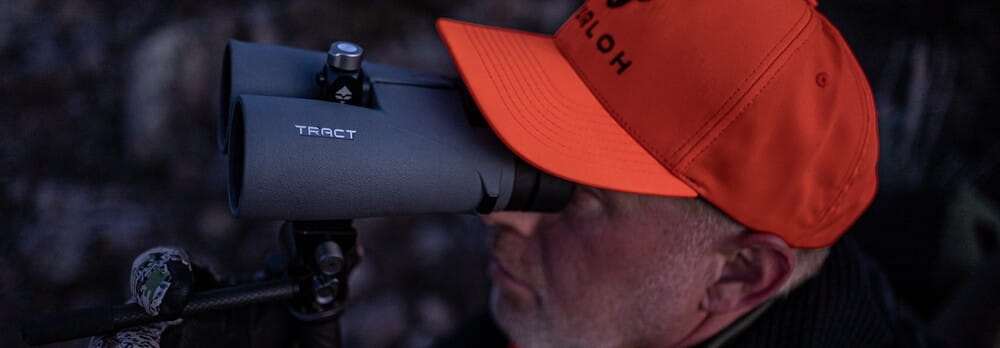
The Aziak Backcountry Lite and the Aziak Vantage pan head not only performed well for us, but blew us away. Stable, compact, lightweight, and versatile, this is the one that stood out. The 45 inch max height isn’t quite as tall as the MTN HNTR SS, but it seemed to offer slightly more stability, and I preferred the Vantage Pan head a little more, particularly because of the weight savings. I also preferred the compact packed size and it is the easiest tripod and head combination I’ve ever used to slide in my pack.
WHAT WE LIKED
- Extremely compact
- Super lightweight
- Ultra stable for an ultralight tripod
- Triangular center column – more stability
- Exceptional pan head (Vantage pan head)
This combination is absolutely killer for a backcountry ultralight setup. While I prefer the Outdoorsmans Carbon Innegra if I’m going to plan to shoot off a tripod, or plan to use a heavy optic a lot, the Aziak Backcountry Lite is an one I don’t hesitate to take on backcountry trips when weight is important, but I still need a solid glassing and shooting setup.
WHAT WE DIDN’T LIKE
- Expensive
The only real downside to the Aziak Backcountry Lite and Aziak Vantage pan head combo is that it’s not cheap, with a price tag nearly $450. If that’s not something you can swallow, the MTN HNTR SS is the way to go.
Leupold Alpine CF-425 Ultralight Tripod
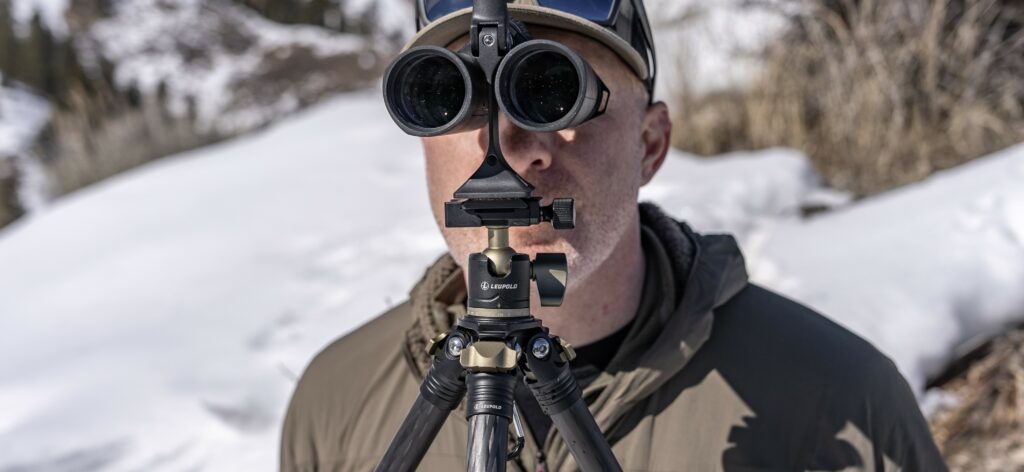
The Leupold Alpine CF-425 carbon fiber ultralight tripod is probably one of the most unique tripods we tested. At first glance, you will likely think it is very similar to all the others, and in a lot of ways it is. However, the Leupold Alpine ultralight tripod can be used as bowl top, or the included ball head can be quickly removed and a center column then screwed on so you have the adjustability of a center column. Certainly an interesting concept that adds versatility.
If you are someone who wants versatility, needs a taller height, but wants to keep the weight to a minimum, the Leupold Alpine is one to look at. It is the lightest tripod in its height class that we tested as well as the most versatile.
LEUPOLD ALPINE TRIPOD SPECS
- Tripod only weight: 25.7 oz
- Tripod and included head weight: 30.9 oz
- Tripod, head, center column: 34.3 oz
- Max Height: 58 inches
- Min Height: 5 inches
- Folded length: 18.5 inches
- Leg sections: 4
- Price (tripod & head): $399.99
OUR TESTING AND EXPERIENCE
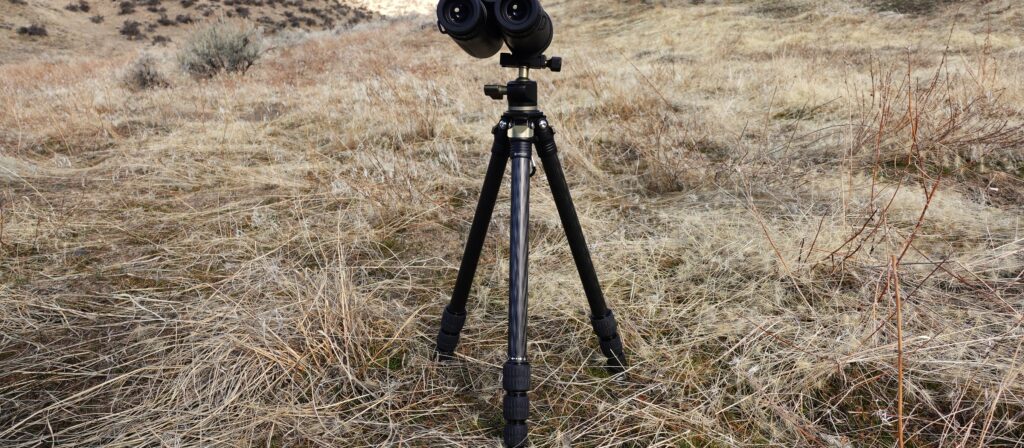
During our testing, we put binoculars, spotting scopes, and even a camera on this tripod to see how it did. As with all tripods, it performed the best without the center column extended and was adequately stable. However, we noticed that it had less stability than others due to the narrower stance of the legs. This was especially true when using the center column and extending it. The tripod was just a bit more susceptible to tipping over than others. However, it is best in its class in relation to its weight to height. At an incredible 58 inch max height and coming in at 34.3 ounces all in, that’s impressive.
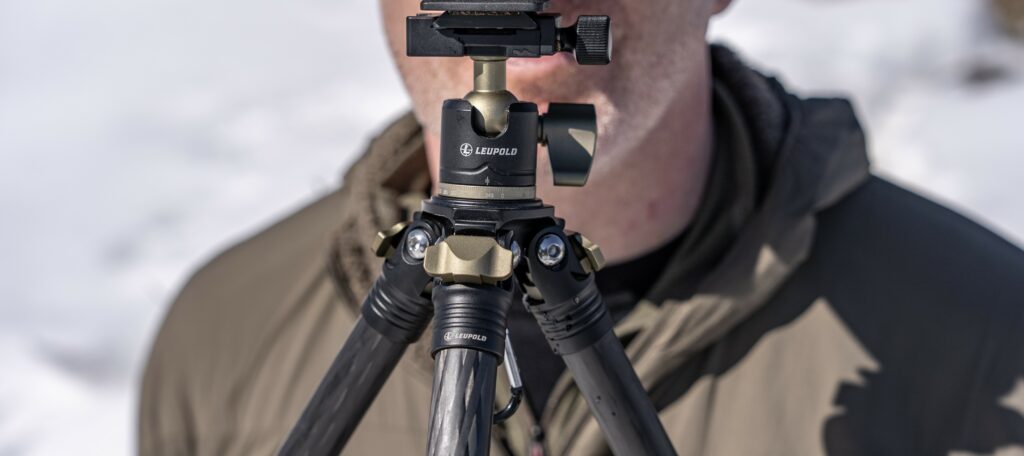
It’s folded length is very nice at just 18.5 inches, but if you leave the center column attached, that adds roughly 8 more inches, which makes it on the long side relative to its max height. The included ball head provides adequate stability, but it does not have a pan feature. It is truly a minimalist style ball head. Anything more than your binoculars and you’ll likely wish you have a more robust head.
WHAT WE LIKED
- Very compact
- Extremely lightweight for its max height
- Very tall for its weight
- Ball head included
- Versatile (bowl top or center column)
The Leupold Alpine tripod is the lightest tripod in its height class, making this a serious consideration if you are looking to shave weight, but still want a tripod that’s plenty tall. With a max height of 58 inches, you can even use this with an angled spotting scope while standing if you have to. The versatility you get is great being able to switch between a bowl top to a center column style tripod. The exchange is a bit cumbersome though as you have to unscrew the ball head, screw on the extension, and then screw on the ball head to the extension post.
WHAT WE DIDN’T LIKE
- Narrow stance – less stable
- Center column protrudes and can’t be collapsed
We found the detachable post to be an odd way to add extra height to your tripod. While the idea is great, and this does give you extra versatility if you want to use the center post, it also adds a lot of extra length to the tripod as the detachable center post nearly doubles the length of the tripod if you leave it on there. It also makes losing this center post easy if you take it off when not in use, but want to bring it with you in the field for glassing. If this height extension post slid down out of the way, it would be a sweet idea and super functional.
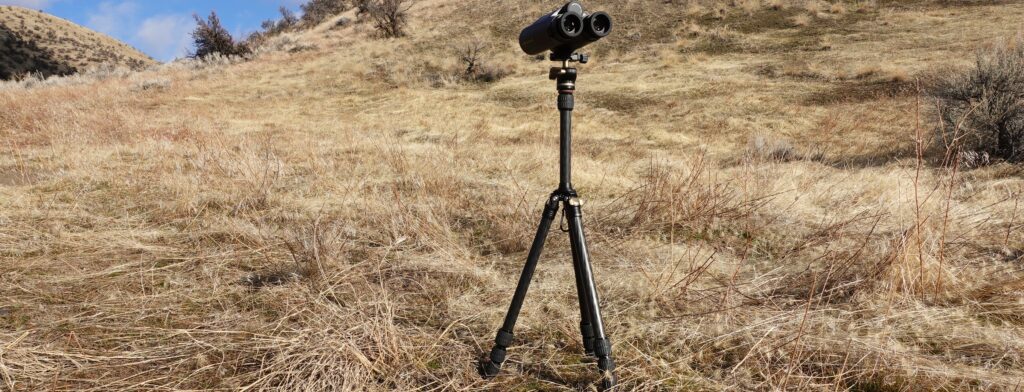
The stance of the Leupold Alpine tripod is also noticeably more narrow than others like the Slik 624 and Slik 635. In fact, the stance of the Leupold Alpine was roughly 8 inches narrower, which made is substantially less stable than others in its class. The tradeoff, however, is that the narrower stance gives the tripod more height at a lesser weight. It’s a give and take.
Slik 624 CF Ultralight Tripod
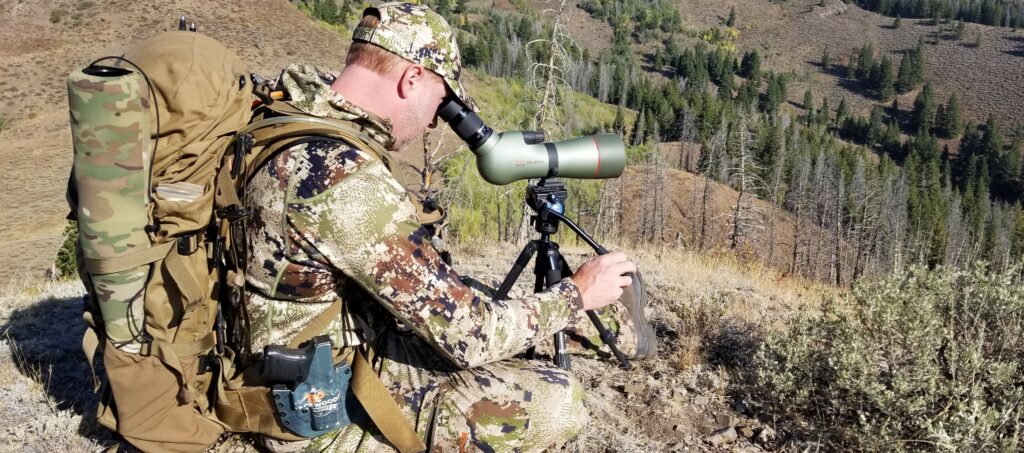
The Slik 624 Pro CF was replaced by the Slik 635 in recent years, but the folks at S&S Archery loved the Slik 624 so much that they brought it back and, as far as I know, that’s the only place to get it now. Why did they love it so much? It features 4 leg sections with a max height of 44.7 inches while coming in at just 30 oz and a very small 15 inch folded height. This makes this a phenomenal tripod if you only need a sitting tripod.
Because of its extremely wide stance combined with the lower max height than others, it is extraordinarily stable for its weight. You give up 14 inches in max height compared to the Leupold Alpine, but adds 3.3 ounces in weight. If all you need is a sitting tripod, this Slik 624 is an absolute gem. Paired with the right head, like the Sirui VA5, it can easily handle everything from a large spotting scope to binoculars, can be used to shoot off of, and compacts down very small.
Slik 624 TRIPOD SPECS
- Tripod only weight: 30 oz
- Max Height: 44.7 inches
- Min Height: 5 inches
- Folded length: 15 inches
- Leg sections: 4
- Price (tripod only): $249.95
OUR TESTING AND EXPERIENCE
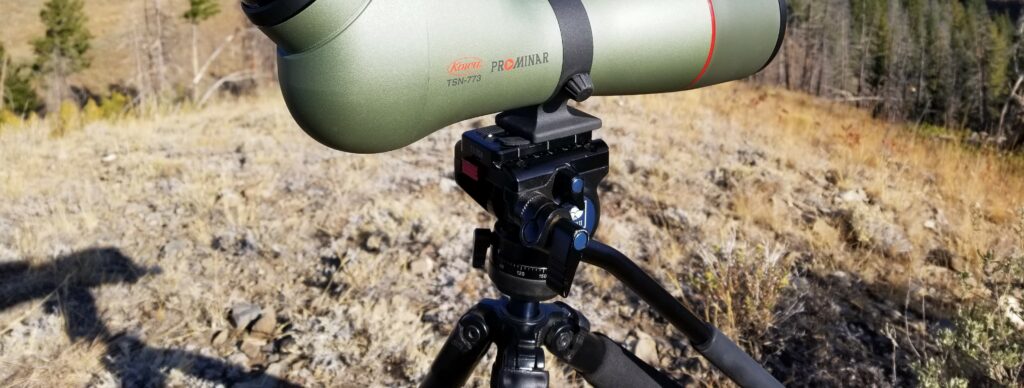
We’ve used this Slik 624 Pro CF for a number of years and it’s been a fantastic all-around performer. It’s been used with everything from binoculars to large spotting scopes, shot off of and filmed from. While it is only a sitting tripod, it gives you enough height to use on steep inclines when needed, and like all of the tripods in this review, the legs can be widened to get extra stability on uneven or rocky terrain, or if you want to sit in a backpacking chair and extend the legs around you.
The feature set that the Slik 624 gives you makes it pretty obvious why the folks at S&S Archery wanted to bring this one back, and it’s become a personal favorite of mine if I don’t need more height than it offers. It is great for backpacking when you need excellent stability without excessive weight, but it isn’t the lightest you can get.
WHAT WE LIKED
- Very compact
- Extremely stable
- Perfect sitting tripod
- Ability to handle small and large optics
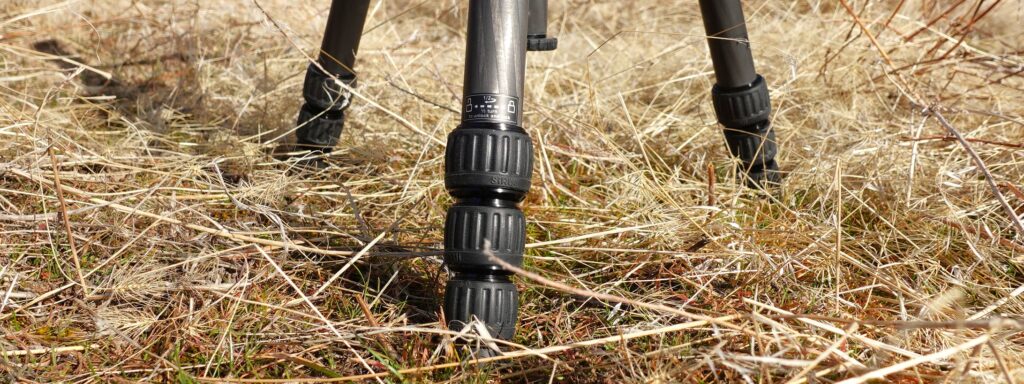
- Excellent twist lock legs
- Removable bottom portion of center column
If all you need is a sitting tripod, the Slik 624 Pro CF tripod is certainly one to seriously look at. It has the perfect feature set for the backcountry hunter looking to keep the weight down, while not sacrificing stability. While it is limited in max height, and like all tripods loses stability when the center column is extended, it does an incredible job of doing everything the backcountry hunter needs in a tripod.
The ability to remove the bottom 2/3 of the center column allows this tripod to be used at a minimum height of just 5 inches, which can be a critical feature for folks who want to shoot prone off of a tripod. All of the Slik tripods offer this which is certainly a nice feature.
WHAT WE DIDN’T LIKE
- Heavier for max height
There wasn’t much we didn’t love about the Slik 624 CF tripod, but relative to the others in this review, it is the heaviest option that offers a shorter height of just 44.7 inches max. As discussed above, the give and take is the extra stability you get with this tripod, but if you want more height than this offers, there are lighter options like the Leupold Alpine or Sirui T–024SK that give you more height in a lighter package.
Sirui T-024SK Ultralight Tripod
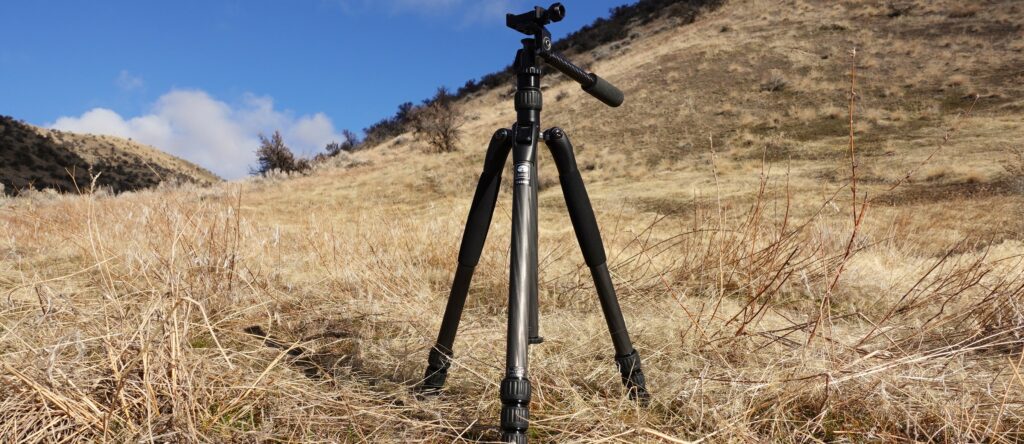
One of the most appealing things about this Sirui T-024SK is its incredible light weight and small folded size in relation to its maximum height of 58.5 inches. In addition to that, it comes in a killer combo with the Sirui VA5 head. This ultralight tripod gives you more than enough height to use sitting down, and enough to use standing up in a pinch, but it’s not the most stable when fully extended. The folded height of 18 inches (not including whatever head you put on it) isn’t the most compact we tested, but it’s certainly more than compact enough to travel in any backpack.
Where the Sirui T-024SK really shines is in the weight savings. Saving roughly 3 ounces over the Slik 635, while offering an additional 7 inches in height makes this a very attractive option for the ounce counter who still wants a tripod with plenty of height. A short center column is included so that you can take advantage of a low 5.5 inch minimum height when needed, but you’ll need to make sure to either swap out the center column before you hit the trail, or bring it with you if you may want to use the longer center column. When using the longer center column, the minimum height is roughly 13 inches plus whatever head you put on it.
SIRUI T-024SK TRIPOD SPECS
- Tripod only weight: 27.9 oz
- Max Height: 58.5 inches
- Min Height: 5 inches
- Folded length: 18 inches
- Leg sections: 4
- Price (tripod and head): $296.00
OUR TESTING AND EXPERIENCE
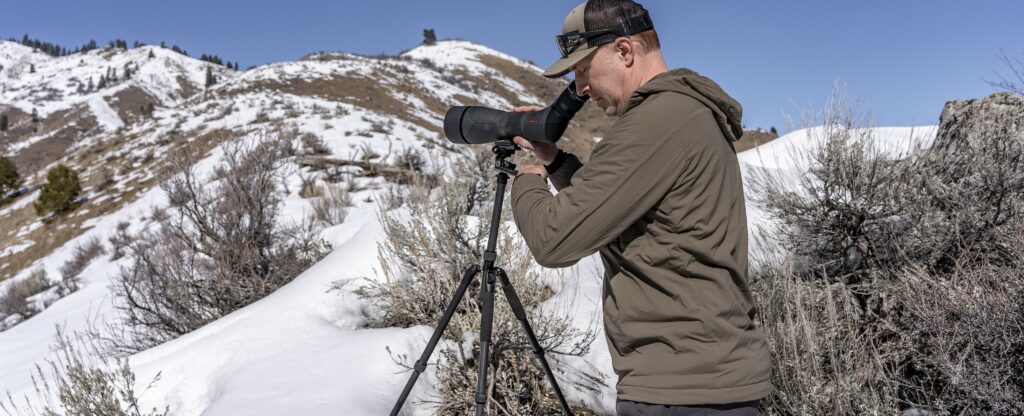
I used the Sirui T-024SK exclusively for an entire season and really enjoyed using it. It is a very versatile, lightweight, and plenty durable tripod for the person who wants to reduce their pack weight as much as possible, but still wants the performance from a tripod that allows for use at taller heights.
During my testing, I loved how compact, easy to use, and lightweight this tripod is. It handled my binoculars and spotting scope with ease, even up to my large Kowa TSN 88A spotting scope. When paired with Sirui VA-5 video head (included in a combo package), this tripod has plenty of stability to handle heavy optics within some limitations.
I found that as long as I didn’t fully extend the Sirui T-024SK with a heavy spotting scope on it, this ultralight tripod was stable enough. As mentioned before, due to the narrow stance of the legs, it wasn’t as stable as some of the others and got pretty top heavy and tipped a little easier than I preferred when at a taller height. I just had to be aware of that and make sure the tripod had good footing and that I didn’t bump it and send my spotting scope crashing.
Once I got the hang of how this ultralight tripod worked to its fullest, it really performed well for me. Here are some of my likes and dislikes after a season of use:
WHAT WE LIKED
- Very compact
- Lightweight for its height
- Ability to handle small and large optics
- Excellent twist lock legs
- Low minimum height (with short column)
If you need somthing that can occasionally be used standing (depending on your height), this is a fantastic option. A bit unstable when fully extended, but usable. Its weight to height ratio and compact size is extremely attractive.
WHAT WE DIDN’T LIKE
- Instability at taller heights
- Not the best as a shooting tripod
- 2 center columns
There is always give and take with gear, and to get the weight savings that you get with the Sirui T-024SK you give up some stability. That lesser stability doesn’t make this the best option for you if you do a lot of glassing with a larger spotting scope, but it handles binoculars and a small spotting scopes, like the Kowa TSN 55 or the Athlon Ares 15-45×65, very well.
Slik 635 Pro CF Ultralight Tripod
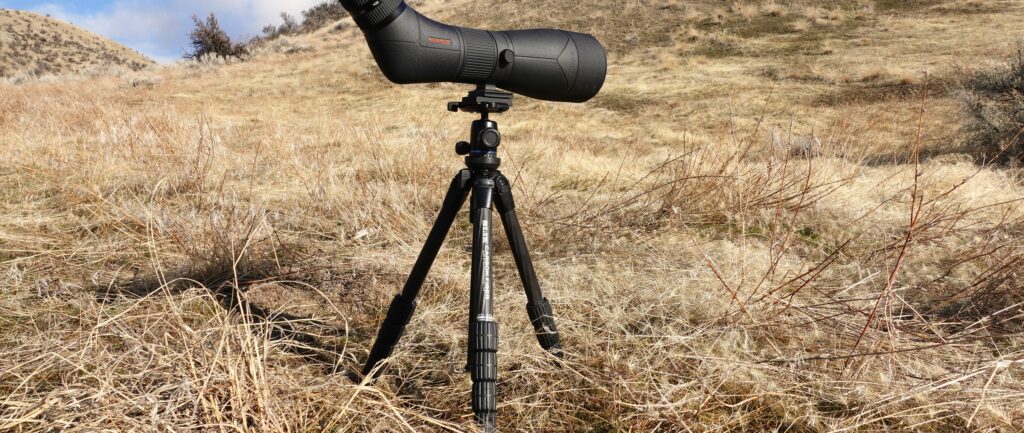
What makes the Slik 635 CF Pro different than others in this review? It features a whopping 5 leg sections, which allows this ultralight tripod to be the most compact in its class, by a long shot. At only 14.6 inches when folded and an impressive 51.6 inch max height, you get a tripod that is super compact, tall enough for use while standing (albeit you’ll have to bend or kneel a little), and ultralight at just 30.7 ounces (without the head). You get more height out of the Sirui T-024SK and the Leupold Alpine tripod, but both of those are nearly 4 inches longer when folded.
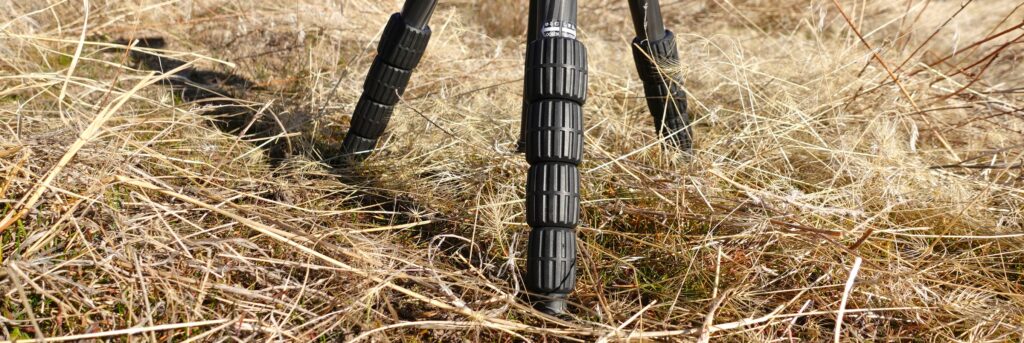
Similar in its 5 leg section design and compact folded size to the Field Optics Research MicroLite Carbon tripod, the Slik 635 offers a much higher maximum height than the Field Optics Research MicroLite Carbon and the Slik 624 CF Pro, making this a great option for those who need a compact tripod that offers more height than your traditional sitting tripod.
Like all Slik tripods we tested for this review, it offers a nice wide base that gives you more stability than others. This wide base creates a much more stable foundation which is absolutely noticeable in the field. The Slik twist lock legs are very user friendly as well and make extending, collapsing, or adjusting the tripod legs very easy.
SLIK 635 TRIPOD SPECS
- Tripod only weight: 30.7 oz
- Max Height: 51.6 inches
- Min Height: 3.5 inches
- Folded length: 14.6 inches
- Leg sections: 5
- Price (tripod only): $269.95
OUR TESTING AND EXPERIENCE
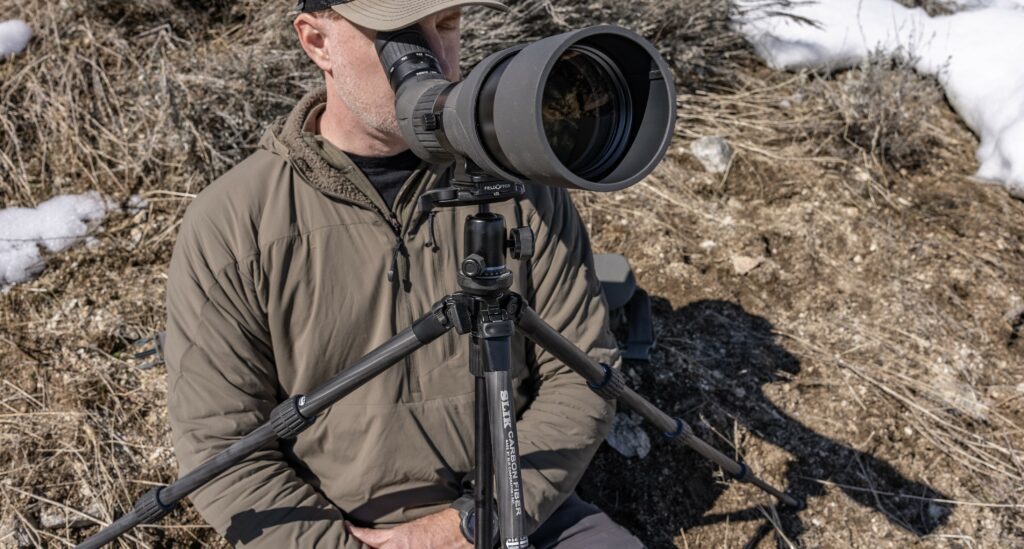
I tested the Slik 635 Pro CF with my camera, many binoculars, and even a bunch of different heavy spotting scopes. As you would expect, this is a tripod built primarily for use while sitting, but can be used standing for short periods. I found there to be quite a bit of flex when the Slik 635 Pro is fully extended, so it’s certainly not the best option of the ones we tested if you find yourself needing this extra height. It is still extremely stable due to the wide base, but with the 5 leg sections, you have more joints and smaller diameter carbon in the lower leg sections, which both decrease its stability.
I found myself doing everything I could to avoid using the smallest (5th) leg section as it has such a small diameter, it had excessive flex. It’s nice that the extra leg section is there for you if you absolutely need to use it, but it’s also not that practical with very much weight on the tripod. It simply flexes too much to adequately support a heavy tripod. Not that there is any fear of it breaking, you just get a lot more vibration, which makes fine tuning your image tough. To combat this, I simply left the 5th leg section unused whenever possible and that helped a lot.
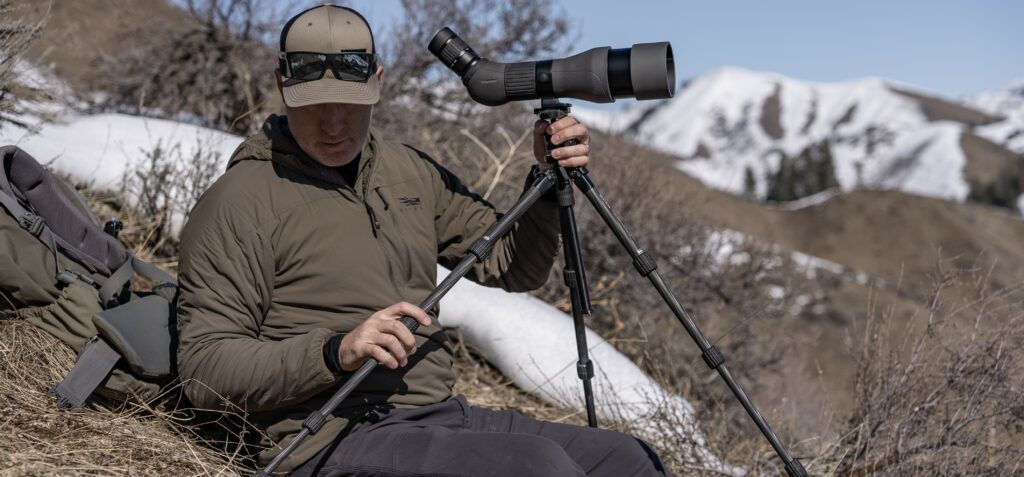
When the 5th leg section isn’t used, the Slik 635 is very similar to the Slik 624, but it has the extra leg section there if needed. The Slik 635 replaced the 624, so this makes sense.
WHAT WE LIKED
- Extremely compact
- Very lightweight for its height
- Ability to handle small and large optics
- Excellent twist lock legs
- Low 3.5 inch minimum height
Like many in this review this is a great ultralight tripod that can occasionally be used standing (depending on your height), but that’s not its ideal use. It excels as a sitting tripod when you need something extremely compact.
WHAT WE DIDN’T LIKE
- 5th leg section creates flex/vibration
- Not ideal as a shooting tripod
- 5 leg sections make it cumbersome to use
At the end of the day, you pay a bit in stability and usable height in exchange for an extremely compact, ultralight tripod. Personally, I really don’t like having 5 leg sections in a tripod as it just adds extra movements and steps to get set up. However, if compact folding size is what you need, you’ll have to be OK with that.
That 5th leg section is so incredibly small in diameter that you get a lot of vibration with a heavy optic, making it almost unusable when fully extended. With lighter optics like binoculars, it’s much less of an issue, but something like the Slik 633 provides far superior stability at a similar weight, but is a lot less compact. It just depends on what you need.
Field Optics Research MicroLite Tripod
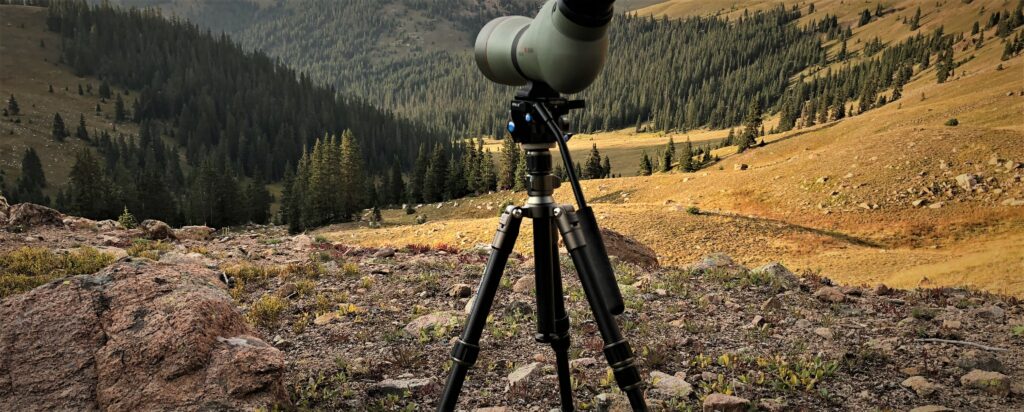
Next up is the Field Optics Research MicroLite Carbon Tripod. This compact little tripod is very similar in specs to the Slik 635 Pro we just looked at, with some very distinct differences. Like the Slik 635, it features 5 leg sections with that 5th leg section being awfully small in diameter. The Field Optics Research MicroLite is extremely compact at 14.8 inches when folded.
One thing that sets this apart is the dual section center pole. This gets the max height up to an impressive 50.4 inches, while having short leg sections. This also makes the total length of the center column (when both are extended) a very long 15 inches.
While this is a great way to add some extra length to the tripod while keeping it incredibly compact, it also adds a lot of flex in that center column. The narrower stance of the Field Optics MicroLite combined with the dual telescoping center column makes it a bit less stable than the Slik 635.
FIELD OPTICS RESEARCH MICROLITE TRIPOD SPECS
- Tripod only weight: 27.8 oz
- Max Height: 50.4 inches
- Min Height: 10.6 inches
- Folded length: 14.8 inches
- Leg sections: 5
- Price (tripod only): $139.00
OUR TESTING AND EXPERIENCE
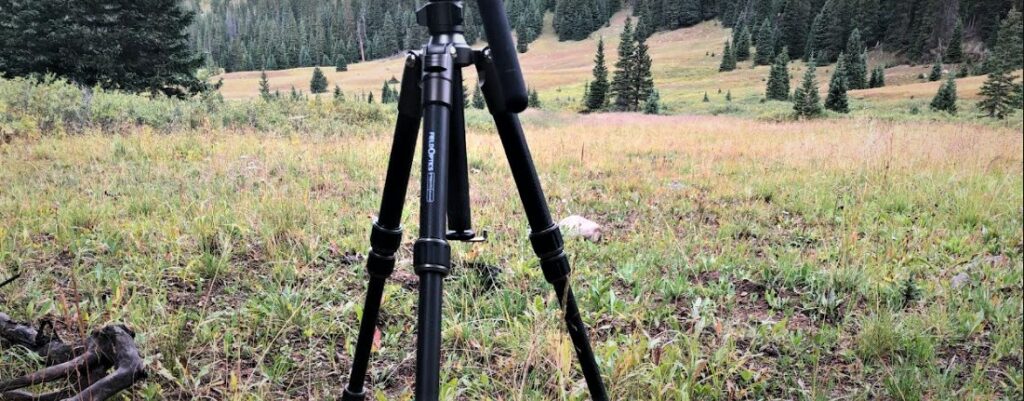
One of our team members tested the Field Optics Research MicroLite for a whole season; from scouting in the summer, archery hunting in September, and rifle hunting in October in Idaho and Colorado. The extra leg section proved once again to be a bit cumbersome, and the 5th leg section is small in diameter, creating more flex and more vibration, particularly with a heavier optic or in windy conditions. This really is designed as a sitting tripod only.
We noted during testing that the two-section center column proved to be less useful than we’d hoped as the combination of the extra joint and very long center column height made it extremely flexible. With both center columns extended, the only real use was with binoculars as there is simply too much flex and vibration to use a spotting scope, unless it was something ultralight like that Kowa TSN 55.
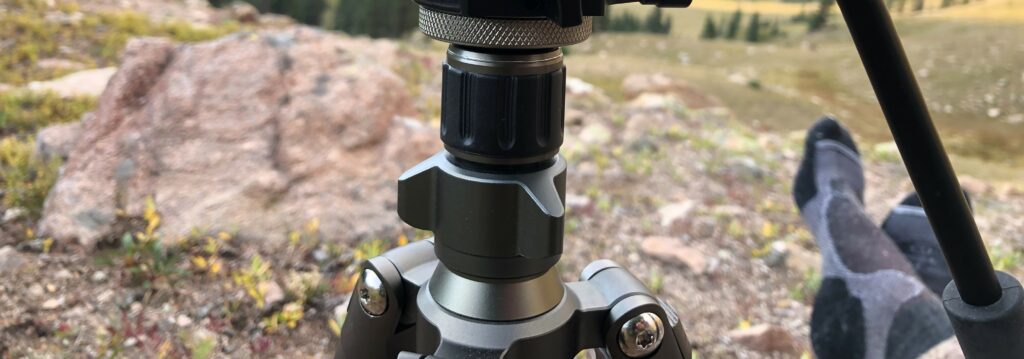
At the end of the day, though, the 5 leg sections, two center column joints, and dual tension adjustments of the Field Optics ULP Pan head (which is what was used with this tripod) made for a TON of adjustments. It got frustrating at times when trying to quickly set up before that animal disappeared into the timber. Like the Slik 635, it is super nice and compact, so that’s the tradeoff.
We also had this tripod come apart on one of the last October deer hunts. A screw had rattled loose and the leg came off. Now to be fair, the rattle should have been investigated before it became that loose and then tightened. Then it certainly wouldn’t have come off. The folks at Field Optics took care of the issue with a phone call, however, which showed their great customer service.
WHAT WE LIKED
- Extremely compact
- Very lightweight for its height
- Super adjustable and versatile
Like many in this review, this is a great ultralight tripod that can occasionally be used standing (depending on your height), but that’s not an ideal use. It excels as a sitting tripod when you need something extremely compact.
WHAT WE DIDN’T LIKE
- 5th Leg section creates flex/vibration
- Not the best as a shooting tripod
- 5 leg sections was cumbersome to use
- 2 section center column added flex and vibration
At the end of the day, you pay a bit in stability and usable height in exchange for an extremely compact ultralight tripod. Personally, I really don’t like having 5 leg sections in a tripod as it just adds extra movements and steps to get set up. However, if compact folding size is what you need, extra leg sections is often the compromise.
Just like that Slik 635, that 5th leg section is so incredibly small in diameter that you get a lot of vibration when fully extended. Add the 2 section center column and it is unusable when fully extended with anything other than binoculars. Something like the Slik 633 provides far superior stability at a similar weight, but at a price of being a whole lot less compact.
Slik 634 Pro CF
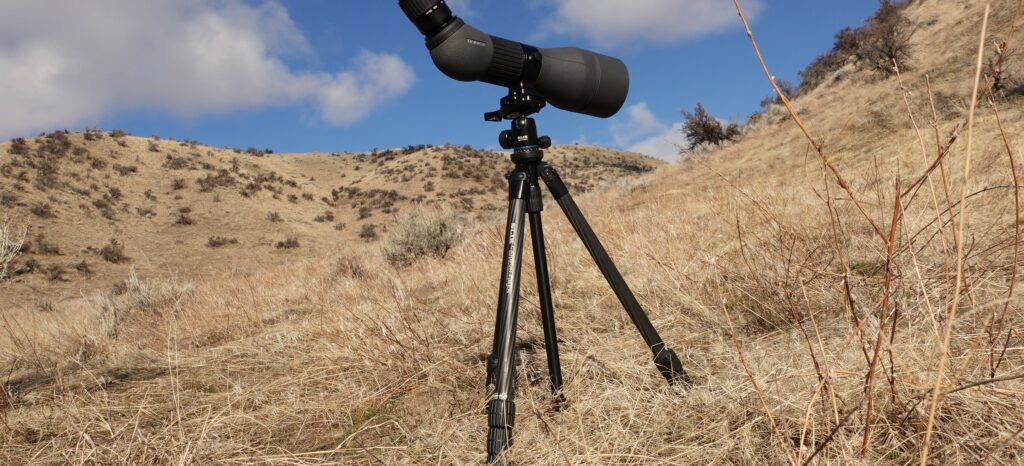
The Slik 634 Pro CF is a very popular option, and for good reason. At an impressive 32.5 ounces, you get a full height standing tripod that is also quite compact, particularly since it’s got a maximum height of 64 inches. Its folded height is also impressive at just 18.7 inches. If you remember, that is quite similar to the Sirui T-024SK and the Leupold Alpine, but it offers you an additional 6 inches in height as well as far superior stability, even when fully extended, over both of those other options.
The Slik 634 Pro CF is often a top choice for folks wanting a tripod that can be used when standing up or when sitting and glassing a hillside. The center column is long, but not as long as the Slik 633 which we’ll look at in a moment. As you likely know, a long center column is oftentimes a recipe for instability, but the Slik 634 Pro CF offers a good combination of features.
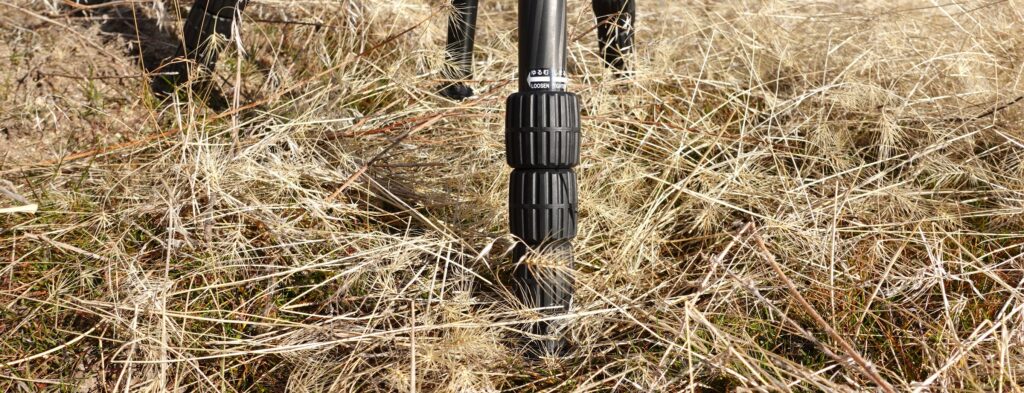
You might be thinking that the Slik 634 Pro CF sounds like the perfect backcountry tripod. Well, it’s not without its imperfections. When put side by side with the next two tripods we’ll look at (The Two Vets Ruck and the Slik 633 Pro CF), it became very apparent that this was the least stable tripod in this class. This is largely due to the 4th leg section being smaller in diameter (but not nearly as small as the Slik 635 or the Field Optics Research MicroLite). However, when compared to the other full size tripods in this class, it simply wasn’t as stable when fully extended.
SLIK 634 TRIPOD SPECS
- Tripod only weight: 32.5 oz
- Max Height: 64 inches
- Min Height: 4.1 inches
- Folded length: 18.7 inches
- Leg sections: 4
- Price (tripod only): $289.95
OUR TESTING AND EXPERIENCE
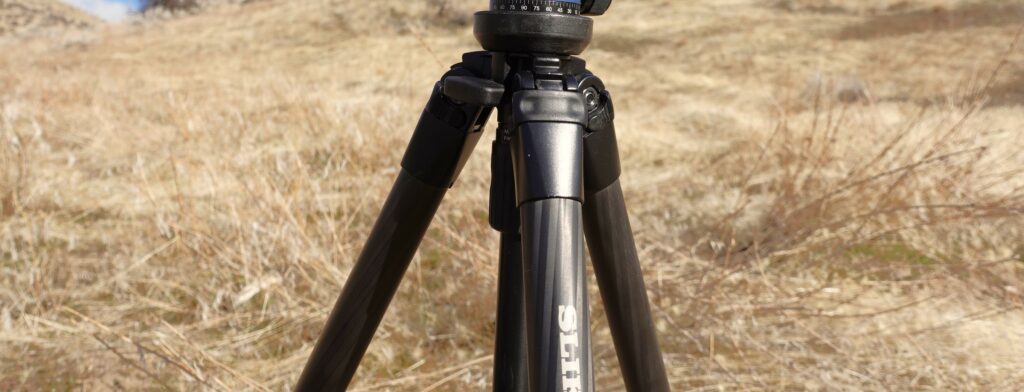
We used the Slik 634 Pro CF during a bunch of our optics testing which included small and large spotting scopes, binoculars, rangefinding binoculars, and some camera work. Overall, we were very pleased with its performance and found it to be a very nice tripod that was great for a wide range of uses. However, during our spotting scope testing, when it was put side by side with others in its class, it simply did not provide the same stability as the Slik 633. It did, however, provide a much more compact package than the Slik 633 and a lighter weight package than the Two Vets Ruck. Pick your poison.
WHAT WE LIKED
- Compact & lightweight for its height
- Max height of 64 inches
- Min height of 4.1 inches
- Great combination of features
- Good for shooting off of
The Slik 634 fits the bill if you are in the camp of needing a lightweight tripod that can be used standing or sitting, but you still need it to be reasonably compact. For a tripod that extends up to 64 inches, this is not only lighter than the Two Vets Ruck, it is also much more compact than the Slik 633. It essentially fits between those two as it is lighter weight but less stable than the Two Vets Ruck, about the same size when folded, about the same weight, less stable than the Slik 633, but much more compact when folded.
WHAT WE DIDN’T LIKE
- Didn’t handle larger optics well
- Less stable/more vibration than other in its class
The Slik 634 Pro CF was not our preferred option for handling a larger spotting scope, even when not extending the center column. While it does give you great height, it really sacrifices in stability and vibration dampening when side by side with the Slik 633 and Two Vets Ruck. When trying to fine focus with a large spotting scope (with the center column lowered all the way down), it had noticeably more vibration when turning the focus knob. Because of this, we’d recommend the Slik 634 for binocular users more than large spotting scope users. It gets the job done and still provides plenty of support, but you’ll have to deal with significant vibration.
Tricer BC Tripod (Tri-Tek Center Column) Review
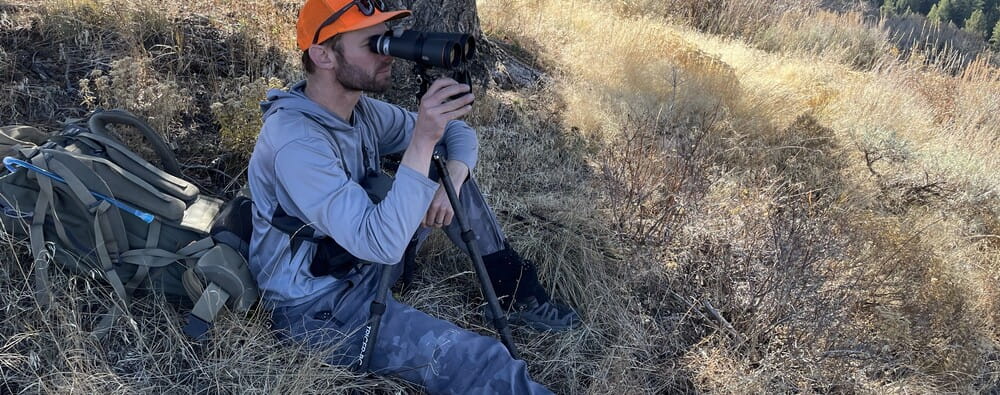
The Tricer BC tripod is light, stable, and super compact, and when paired with the Tricer LP pan head, you have an ultralight backcountry setup weighing under 2lbs. While not quite as ultralight as the Aziak Backcountry Lite or the MTN HNTR SS, it offers added stability with its thicker diameter inverted legs. Tricer recently updated both the Tricer BC and Tricer AD models with their Tri-Tek center columns, adding stability and a more compact folded profile.
With a weight of 26.8 ounces, it’s certainly not the lightest, but as you’d expect, you are trading extra stability for that extra weight when compared to the lighter weight options. This is one of the most stable tripods we tested in this weight category, with only the Outdoorsmans Carbon Innegra offering a more stable platform. This Tricer BC is more than stable enough to shoot off, glass with binoculars and/or large 80mm spotting scopes, and use large cameras off.
TRICER BC SPECS
- Tripod only weight: 26.8 oz
- Max Height: 40 inches
- Min Height: 3.22 inches
- Folded length: 14.88 inches
- Leg sections: 3
- Price (tripod only): $369
- Price (BC & LP pan head) $588
OUR TESTING AND EXPERIENCE
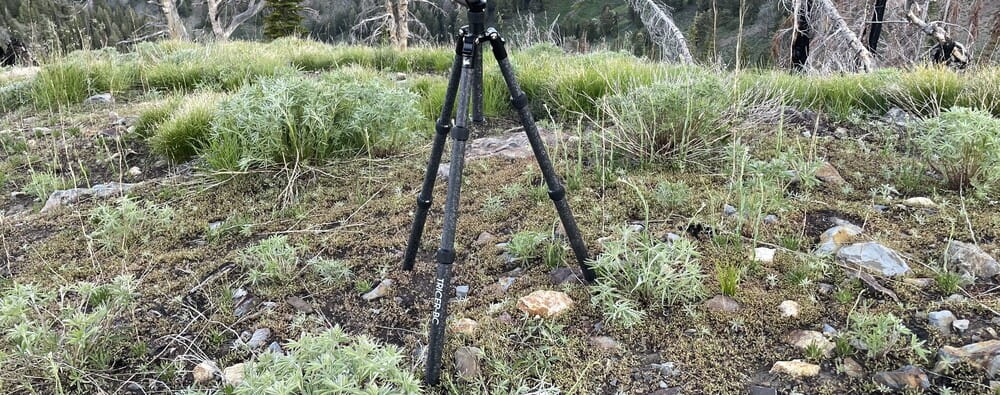
Most of our use has come with the pre-Tri-Tek version of this tripod, so when Tricer released this new updated model, we were super excited to get our hands on it and see if the changes actually made a noticeable difference. The result, a resounding YES. We found the new version to offer a much much more slim folded profile, more stability with the new Tri-Tek center column and smoother operating leg deployment. Since we haven’t had significant time with this version in the field, time will be the best judge, but the early results are phenomenal.
You still have the inverted legs and reverse threads on the locking mechanisms for the legs, which definitely takes some getting used to, but the thicker diameter and inverted legs seem to make a notable difference in stability. The 40 inch height isn’t as generous as either the Aziak Backcountry Lite of the MTN HNTR SS, but its plenty tall for as a sitting height tripod. A little more height would be a benefit, but not needed.
WHAT WE LIKED
- Ultra-Compact
- Tri-Tek triangular center column
- Large diameter legs
- Robust, stable center column
- Extra stability
- Excellent for shooting off
Simply put, the Tricer BC tripod is one you’ll grab if you don’t want to compromise on stability, and are ok with a few extra ounces to accomplish that. Not the lightest in the group, but ultra stable and ultra compact.
The center column on the Ruck was hands down our favorite as it offered the most stability with its triangular shape and smooth operation. Additionally, throughout the course of use during an entire hunting season, none of the legs loosened one bit (a personal pet peeve of mine when that happens), and it offers a nice wide stance like the Slik series (although not quite as wide), giving you plenty of stability.
WHAT WE DIDN’T LIKE
- On the heavy side for it’s height
- Reverse thread twist lock legs
- On the expensive side
All gear offers tradeoffs, and the Tricer BC it’s no different. When stability is more important than weight savings, the Tricer BC is a fantastic blend of weight savings and rock solid stability for any pursuit.
USE CODE “BACKWOODS” FOR 10% OFF YOUR TRICER ORDER
Outdoorsmans Carbon innegra Review
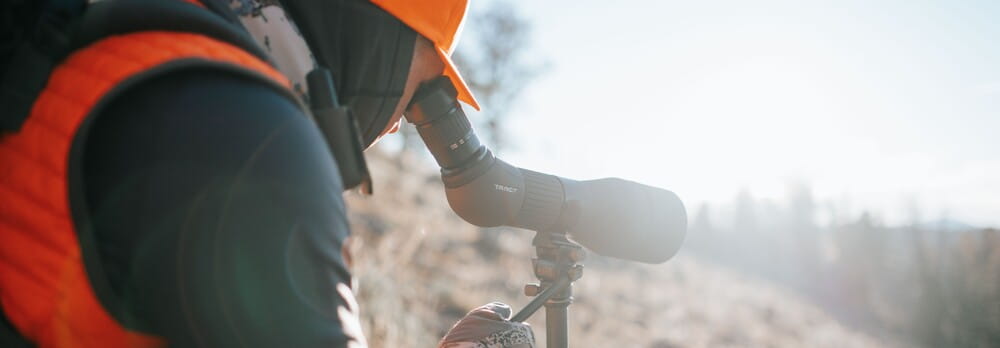
The Outdoorsmans Carbon Innegra just barley sneaks into this 2lb weight category, coming in at 31 ounces. With a max height of 38.28 inches, it is not quite as tall as others, but it offers the most stability of any tripod we’ve reviewed. Hands down. Yes, there is a weight penalty, but if stability is your priority, there is nothing better or more durable.
The Outdoorsmans Carbon Innegra features lever locks rather than twist locks…then only one in this review with such locking mechanisms. Outdoorsmnas states that its a hill they’ll die on. The fact is (in my experience), they are absolutely correct in that they are faster and easier to deploy. The downside? They are more bulky and tend to snag on your pack when attempting to slide the tripod into the side pocket or pouch. Annoying? Yup. A deal breaker? Maybe for some, but the tradeoff here is the speed and ease of deployment.
Another feature the Carbon Innegra offers in their new “Pro” center column is the ability to remove the lower 3/4 of it and either save weight or allow the user to shoot prone off of it. A massive upgrade that users were asking for. After all, why carry such a stable tripod if shooting prone off it wasn’t an option. Even with a super long center column, the Outdoorsmans Carbon Innegra is crazy stable, even with the center column fully extended.
OUTDOORSMANS CARBON INNEGRA SPECS
- Tripod only weight: 31 oz
- Max Height: 38.25 inches
- Min Height: 3.22 inches
- Folded length: 14.75 inches
- Leg sections: 3
- Price (tripod only): $1429.99
- Price (Innegra & Micro pan head) $1,829.98
OUR TESTING AND EXPERIENCE
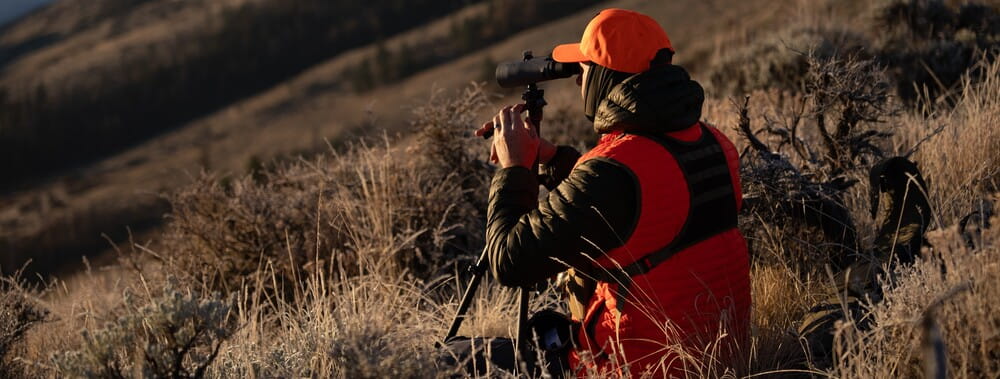
I’ve been beating up Carbon Innegra for several years now, and you can hardly tell I’ve used it. The best way I can describe it is “Industrial”. It’s not ultra refined like the RRS Ascend, but none the less it is equally as stable. From binoculars to large spotting scopes, this thing is absolutely rock solid.
I didn’t find the Outdoorsmans Micro Pan Head to be nearly as smooth as others we tested in this review, so I opted to put the Aziak Vantage pan head on this Carbon Innegra for our Colorado hunt, and fell in love with the combination.
WHAT WE LIKED
- Insane stability
- Quick deployment of legs
- Rock solid center column
- Short folded length
- Large diameter legs (extra stability)
- Excellent for shooting off
- 100% made and sourced in USA
Simply put, the Outdoorsmans Carbon Innegra is the tripod I grab every time if I need ultimate stability and durability, but I’m OK with a little extra weight. You’ll have to take a deep breath before pulling the trigger on it though as it’s the most expensive option in this review…by a LONG WAYS. Being 100% made and sourced in the USA come with a significant price tag unfortunately, but Outdoorsmans has long been proud to say they are 100% USA made and you won’t find anything more durable.
WHAT WE DIDN’T LIKE
- On the heavy side for it’s height
- Not a sleek in design
- Center column on the long side
- On the expensive side
Even with all it’s accolades, the Outdoorsmans isn’t perfect. When folded, it’s one of the most bulky of the group due to the lever locks and a wider “cradle” where the legs come together. It’s especially noticeable when put next to the super sleek Aziak Backcountry Lite. I also didn’t love how long the center column was, and the lever locks tend to hook on my pack.
Bottom line, you buy the Outdoorsmans if you want USA made uncompromising stability and durability, and it is absolutely top shelf in both of those categories.
Slik 633 Pro CF
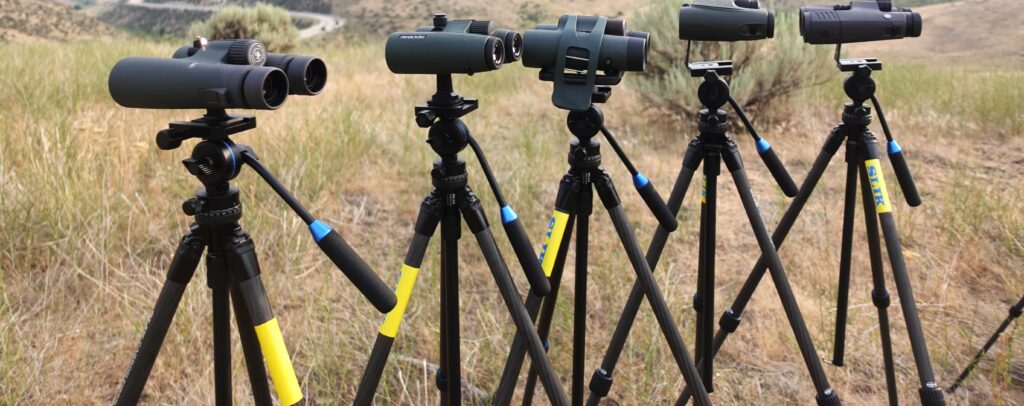
The Slik 633 Pro CF is next up in our search for the best ultralight tripod, and this one is tough to beat if your wanting to keep the weight down but still have a standing height tripod. Coming in at an impressive 32.5 ounces, and extending to a full standing height of 64.2 inches, the Slik 633 provides you one of the best combinations of stability and height that we found (for a standing height option). Even though I didn’t expect it, I found myself grabbing the Slik 633 much more than I anticipated.
In fact, I even found myself grabbing this tripod on many occasions in place of my preferred sitting option, the Slik 624, because the Slik 633 only gave me a 2.5 ounce weight penalty in exchange for the ability to glass standing up if I wanted. I found myself liking the ability to change glassing positions from sitting to standing during long glassing sessions when sitting starts to get old, or those occasions when the brush is too tall to glass sitting down. This surprised me as I had previously settled on just glassing while sitting.
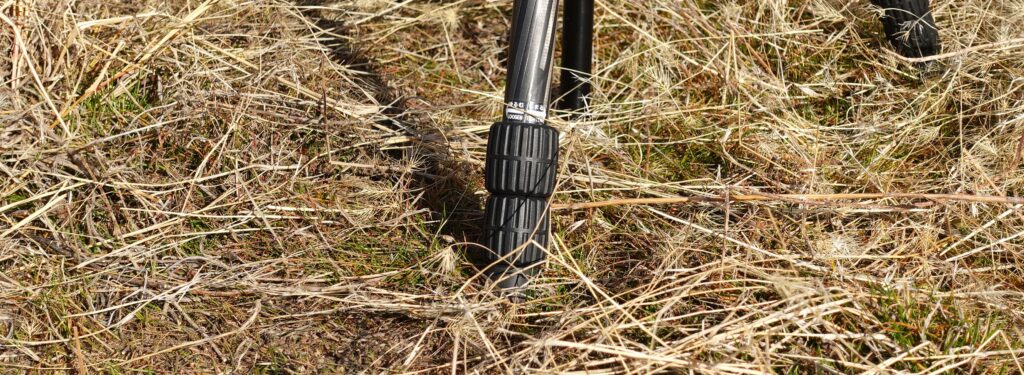
In addition, the Slik 633 still gave me great stability, even when standing, and even provided adequate stability for large optics such as the Kowa TSN 88A, which I used during my Idaho mule deer hunts. The combination of this Slik 633 with the Sirui VA-5 video head provided plenty of stability for everything from binoculars, large spotting scopes, and even a stable shooting platform. When the Aziak Vantage pan head came to market, I swapped that out in place of the Sirui VA-5 for the weight savings, and have loved that combo.
Now, that’s not to say that it was the most stable tripod we tested. As mentioned above, that award goes to the Outdoorsmans Carbon Innegra, but the Slik 633 was good in context with it’s max height and weight. The Slik 633 also gives you the ability to unscrew the bottom 3/4 of the center column, allowing you to shoot prone off this tripod, or set up your camera for that perfect angle.
SLIK 633 SPECS
- Tripod only weight: 32.5 oz
- Max Height: 64.2 inches
- Min Height: 4.9 inches
- Folded length: 21.3 inches
- Leg sections: 3
- Price (tripod only): $289.95
OUR TESTING AND EXPERIENCE
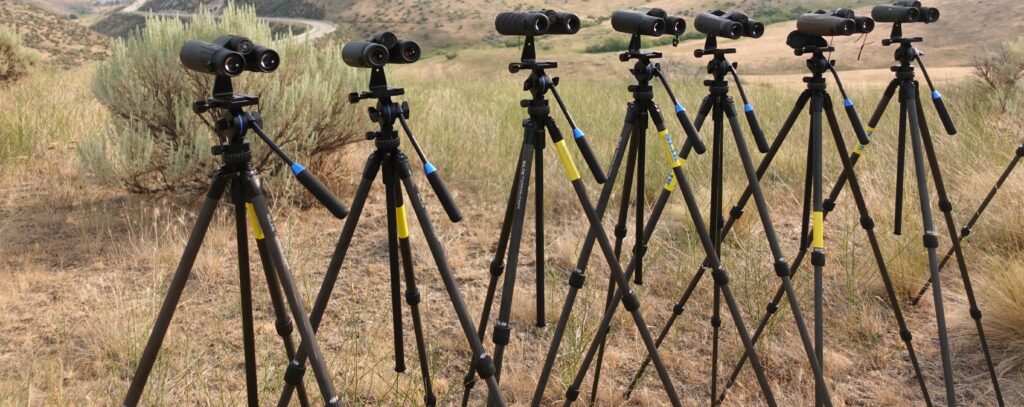
I used the Slik 633 for an entire year, and over the course of that year testing it, I came to love it. While not the lightest or most compact in this review (by a long ways), the overall functionality was hard to ignore. As we discussed at the beginning, what functions are most important to you in a tripod might not be the same as they are for me or the next guy, and that’s 100% okay. While I knew I was sacrificing in folded size and overall weight, the Slik 633 makes up for that in stability, versatility, and ease of use.
Why? The Slik 633, like a few others in this review, has only 3 legs, meaning fewer joints that can flex and less twist lock knobs to operate when deploying or folding up the tripod. On the flip side, however, this also means that when folded, it is the least compact option. For some, this will be a deal breaker as the Slik 633 is the longest one we tested at a whopping 21.3 inches in length. That might simply be too long for what you’re wanting.
WHAT WE LIKED
- Decent stability at all heights
- Max height: 64.2 inches
- Minimum height: 4.9 inches
- Max height of 62.5 inches
- Adequate for shooting off
- Nice wide stance
- Great twist lock legs
The Slik 633 presented a fantastic combination of features, but notably gave exceptional stability no matter if you had the center column extended or not. Of course, you do lose some stability the further you extend the center column, but it was less affected than the Slik 634 when the center column was fully extended. I believe that is because it has one leg less, and that the smallest leg section is significantly thicker than the smallest leg section of the Slik 634. The combination of the smallest leg being thicker in diameter and having one less leg altogether simply makes this tripod more stable at taller heights.
Personally, I absolutely loved have only 3 leg sections as this made deploying and folding up the Slik 633 faster and easier when it came time to set up or pack up and move.
WHAT WE DIDN’T LIKE
- Minimum height: 16 inches
- Super long center column
- Long folded height: 21.3 inches
- Significant stability lost when center column extended
At this point, you might be wondering if there are any downside to the Slik 633. The answer is YES. The Slik 633 has an incredibly long center column, which can get in the way when using this as a sitting tripod. That long center column also causes significant shake when trying to stabilize a heavy optic with the center column extended.
After a few days of use, however, I found a way around the long center column getting in the way when sitting by making sure I set the legs at a height that required me to use at least 6 inches of the center column and the problem was solved. None the less, it is still an inconvenience as you always lose some stability when using the center column.
The other huge downside to the Slik 633 CF Pro ultralight tripod is that it is the largest by a long shot when folded. For a lot of folks, having a nice compact setup is absolutely critical, and for others it’s not a big deal to slide this 21 inch folded ultralight tripod into the side pocket of a pack and get to hiking. Different folks will have different needs, but personally I didn’t mind the extra folded length.
MTN HNTR Swift TS Review
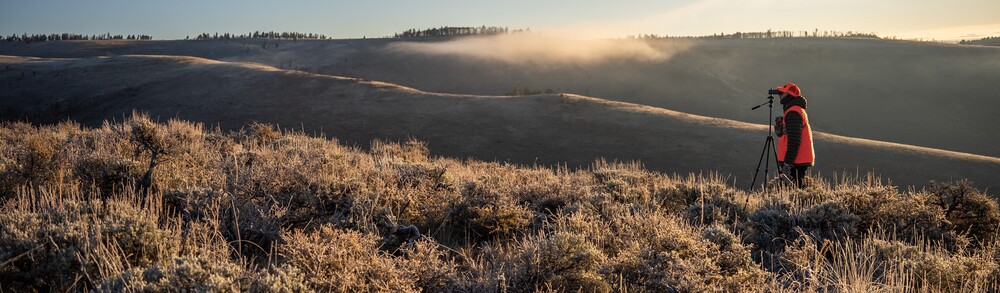
Last but certainly not least, the MTN HNTR Swift TS was tested. If standing height and lightweight is your jam, the MTN HNTR Swift TS is absolutely worth a look. Competing directly with the Slik 633 with it’s 3 leg sections, a longer folded length, at just 34.5 ounces it is roughly 2 ounces heavier than the Slik 633, however it is also an inch shorter when folded up. Conversely, it’s max height is 2 inches shorter than the Slik 633, but lets be real here….you aren’t going to be using either of these with the center column fully extended with much success with anything other than binoculars.
While the center column fully extended on Swift TS is just fine for use with binoculars, anything heavier than that is going to be pretty shaky. Personally, I don’t like setting my expensive spotting scope atop a tripod that far off the ground unless it’s super stable.
Because there is very little weight penalty for this standing height MTN HNTR Swift TS tripod when compared to many others in this review, having the ability to glass standing up if needed is certainly nice. I had that exact situation last year when my sitting height tripod wasn’t getting me high enough to glass over the tall sage brush. I wished I’d brought a taller tripod on that trip. While it’s not exceedingly stable overall, it more than gets the job done, particularly for a standing height tripod at just over 2lbs.
MTN HNTR SWIFT TS SPECS
- Tripod only weight: 34.5 oz
- Max Height: 62.2 inches
- Min Height: 3 inches
- Folded length: 21.3 inches
- Leg sections: 3
- Price (tripod only): $329.95
- Price (Kit – tripod & Nano Pro Head): $419.95
OUR TESTING AND EXPERIENCE
Over the last summer I used the MTN HNTR Swift TS in many situations and found myself gravitating towards it when I wanted a standing height lightweight tripod. While not the best with a heavy optic, I thought it did better than the Slik 633 overall, even thought there were things I preferred about the Slik more. Fewer leg sections are quicker to deploy, but you likely won’t get this MTN HNTR Swift inside the side pocket of your pack.
WHAT WE LIKED
- Reasonable stability at all heights
- Max height: 62.2 inches
- Minimum height: 3 inches
- Adequate for shooting off
- Shorter center column than the Slik 633
- Excellent twist lock legs
The MTN HNTR Swift TS is another fantastic option similar to the Slik 633, but I felt like it offered a little better stability overall. It is a slightly heavier though. I still don’t recommend running the center column all the way up though with anything but binoculars, as a lot of stability is lost.
WHAT WE DIDN’T LIKE
- Narrower stance
- Long folded height: 20.5 inches
- Significant stability lost when center column extended
The primary downside to the MTN HNTR Swift TS is the narrower stance, making it more tipsy with a heavy optic atop it if you use much of the center column I’d love to see a slightly wider stance, like they did with the MTN HNTR SS.
The Results – Our Picks
Here are our picks for each category after testing each of these over the last 5 plus years. Naturally, these are just our personal preferences, so take it within the context of how they were used and the style of hunting we used them for. Some things are simply personal preference, while others are very definable and measurable.
Best Ultralight Tripod
Aziak Backcountry Lite
Our favorite ultralight option was the Aziak Backcountry Lite and Vantage pan head combo. Well under 2lbs total weight, compact, slim, and a solid platform, this thing is a dream to pack, stable enough for any optic you’ll use in the backcountry, and even stable enough to shoot from (we did).
Runner Up: MTN HNTR SS
Best Overall Hunting Tripod
Outdoorsmans Carbon Innegra
The absolute best combination of stability, weight and durability we’ve ever found, the Outdoorsmans Carbon Innegra is our choice for the overall best hunting tripod. It’s a little bulky, and VERY expensive, but it’ll be the last tripod you ever need to buy and give you unparalleled stability without a big weight penalty.
Runner Up: Tricer BC
Best Weight/Stability/Price/Feature Combination
Tricer BC
It’s tough to beat the total package of the Tricer BC. It’s not the lightest, the most stable, most compact, least expensive, or tallest for it’s weight, but its a top performer in all of those categories. There is no compromise in any area and finds the most unique balance of all the important aspect of a backcountry hunting tripod. The package as a whole is top notch and tough to beat.
Runner Up: Aziak Backcountry Lite
Best On A Budget
MTN HNTR SS
While the MTN HNTR SS isn’t the least expensive in the group, it offers the best value in weight, stability, and features for the money. Still a chunk of change, but it’ll give you everything you need for a legit backcountry setup.
Conclusion
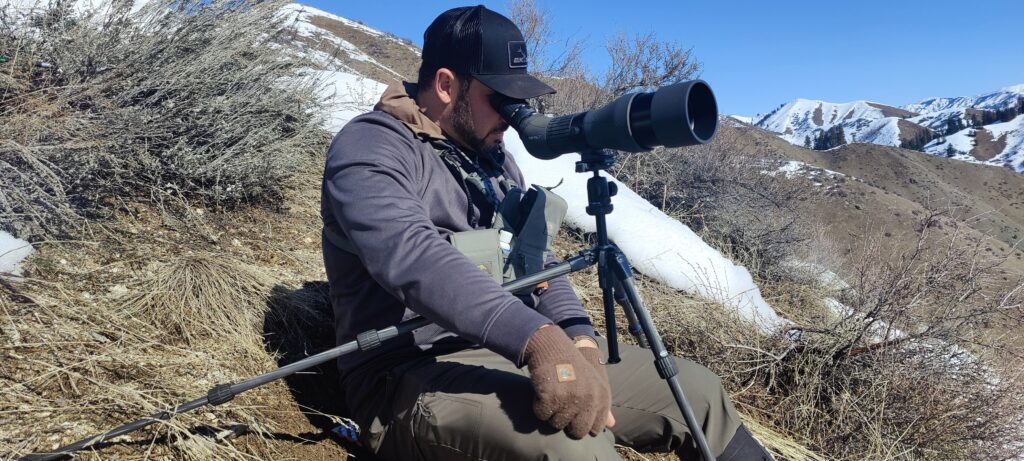
At the end of the day, there is a very long list of factors to consider when selecting what the best ultralight tripod is for your needs. There is simply no right or wrong answer here. You’ll just need to decide what you want your tripod to accomplish and what the best combination of size, weight, stability and packability is for you.
Most folks will agree that weight savings is a big deal, but at the same time, not at the expense of the performance. For this reason, make your list of the non-negotiable features and work down your list of priorities to narrow down your selection. Stick to your list of priorities or you’ll find yourself going down a path that might not take you to the best option for your needs.
Subscribe to Backwoods Pursuit to get Your FREE Backcountry Gear Worksheet!!!
Dial in your gear list, calculate your pack weight, and lighten up your pack with this handy tool!
You do a fantastic job of covering the things that use hunters need, or of course want, and in a way that is informative enough with data but without bogging us down with too much. I appreciate your YouTube channel and website.
Thank you so much for the kind words, David and I’m glad you’ve found the content helpful. Thanks for following along!
This would have been extremely useful if you hadn’t neglected to include any information on price.
Thanks for the feedback. I’ll see what I can do there.
Comparing the best <2lb tripods, and you didn't evaluate the Outdoorsman?
Hey John! I actually just got my hands on the Outdoorsmans Carbon Innegra and was able to use it this fall. It barely squeaks in under the 2lb mark at 1lb 15 oz, but it is certainly in a different class of stability than the ones in this review. The Outdoorsmans Carbon Innegra is my personal favorite tripod when I don’t need ultralight, when stability is more important than ultralight. Since this review, I’ve also tested the newer Aziak Backcountry Lite (https://backwoodspursuit.com/aziak-backcountry-lite-tripod-backwoods-best/), which is my personal favorite of the ultralight category as noted in that review. I did review the Outdoorsmans Carbon Innegra in the standard version here in this video: https://youtu.be/dGHCnjCGomI?si=qjytNJCTwaJv2jay
Thanks for reading!
so take it within the context of how they were used and the style of hunting we used them for. Some things are simply personal preference