

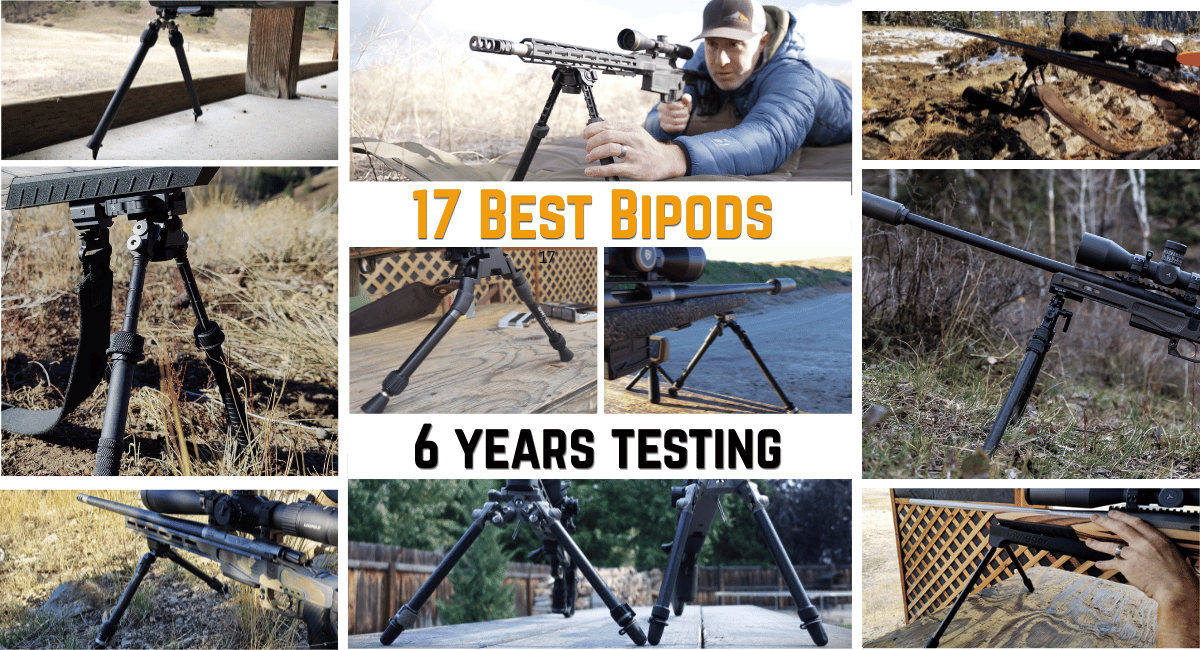
If you’ve spent much time behind a rifle, you likely have used or considered using a bipod. What is the best rifle bipod for hunting? What is the best rifle bipod for shooting on uneven terrain, and how important is it to have the ability to cant and pan? Over the last 6+ years we have used and tested 16 of the best rifle bipods for hunting that we could get our hands on.
Make sure to check out our other gear reviews and the Backwoods Pursuit YouTube Channel to help you decide what gear will help you stay out in the field longer!
Whatever your hunting or shooting endeavor, using a bipod will absolutely tighten your groups and make you a more effective and accurate shot. They don’t come without penalty, though, as you are adding weight and bulk to your rifle. For some, this isn’t worth it, but for many, it is absolutely worth packing around.
4 Reasons To Use A Bipod On Your Hunting Rifle
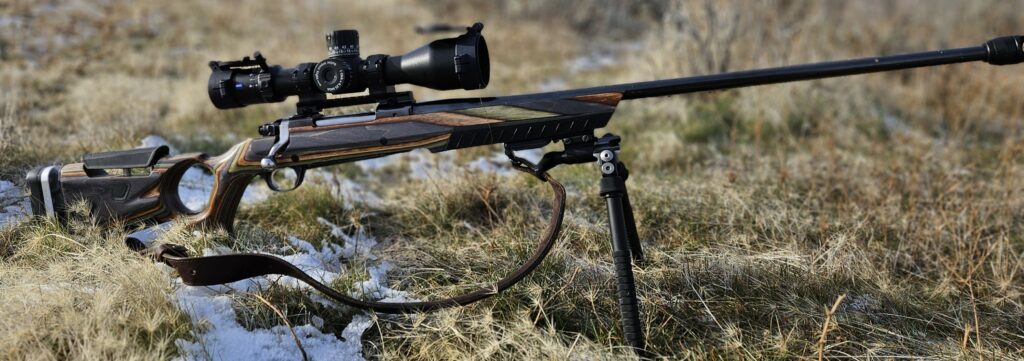
Personally, I am a huge fan of bringing a bipod while hunting, and I rarely, if ever, head out on a hunting trip without one attached to my gun. The benefit that I’ve found from having one has simply made shots possible that otherwise wouldn’t have been (short of having the right tripod setup). In the past I’ve always just used my backpack, the nearest tree, or a rock for my stability. That worked for many years growing up, but looking back, I missed a lot of opportunities because I didn’t have good stability for my rifle.
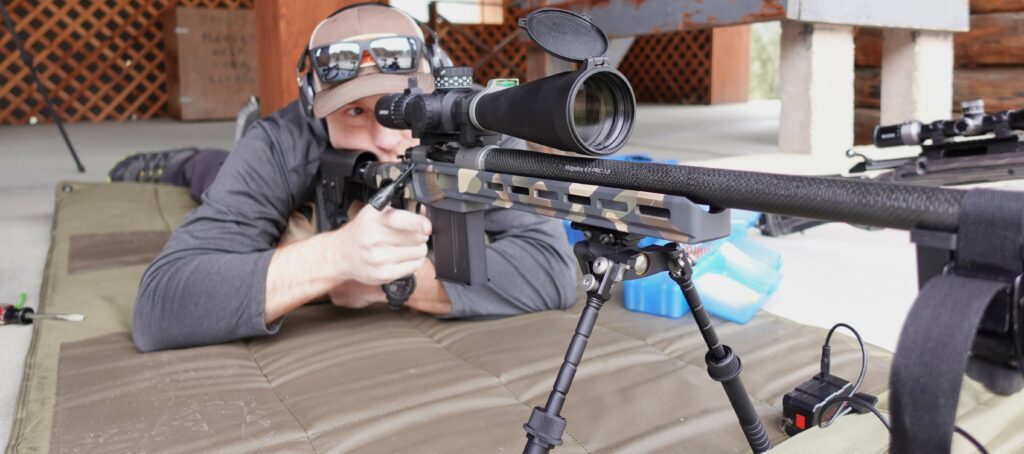
In a few short bullet points, here are my top 4 reasons to take a bipod in the field when hunting:
- Take range day accuracy to the field
- Drastically extend your effective range
- Many bipods offer quick release options so they don’t have to stay on your rifle until you need it
- Get more shot opportunites that would otherwise not be possible
4 Reasons NOT To Use A Bipod On Your Hunting Rifle
There are plenty of reasons that can be thrown out there NOT to use a bipod on your hunting rifle. While I personally am a fan of having the best bipod I can find on my hunting rifle setup, I can also understand the reasons some folks don’t:
- Adds bulk and weight to your rifle
- Bipods snag on branches/trees and are annoying to carry
- Why put an extra pound on your rifle when you will use it for a few seconds
- You can shoot off your tripod just as effectively (but not nearly as quickly)
What Height Bipod Do I Need?
While this is largely a topic that is determined by the kind of shooting you will most likely find yourself doing in the field, there are a few factors that remain true:
- The lower to the ground, the more stable you will be
- Getting prone shots in the field isn’t always possible
As you might have picked up on, those two factors are in direct contradiction to each other, so when picking the best bipod for your needs, it is always a balancing act. How tall of a bipod do I take, without compromising my stability for a longer shot, while still giving me the versatility needed to cover as many shooting positions as possible- without adding excessive weight or bulk.
HERE’S WHERE I PERSONALLY LANDED:
I found that 4-9 inch bipods are too short. After testing and finding that too often, I had to stack my pack or rocks to get enough height to make a shot over a bush.

For me, those taller bipods like the Swagger Hunter 42 are often simply too tall and heavy to realistically take into the backcountry, although they are nice for if you are utilizing a side by side or 4 wheeler. I found a sweet spot for the terrain I hunt in requires a minimum adjustment range of around 7-14 inches, and if it allows me to go even higher for a steep uphill shot (like the Gunwerks Elevate Ti or the Tricer RP), even better. Yes, I know, that does also compromise stability to some degree, but it also allows me take advantage of FAR MORE situations that a 4-9 inch bipod.
Love optics? We certainly do here at Backwoods Pursuit, so make sure to check out our MONSTER 26 BINOCULAR REVIEW, as well as our massive 19 SPOTTING SCOPE REVIEW. For both of those reviews, we lined up the optics and tested them side by side!
Some like the Atlas line of bipods have a 4 inch extension that can be added to the legs, which I found to be a perfect solution. When at the range developing a load or getting some practice in, that 4 inch extension is too much, so I remove it and go back to the 4-9 inch range, which is perfect for the range. When it’s time to go hunting, install the 4 inch extensions and I now have a 8-13 inch bipod, which proved to be just enough to make some of those shots I otherwise wouldn’t have been able to.
SHOOT OFF A TRIPOD
A little off topic here, but my system as a whole includes a bipod as described above, and that is complimented with setting up my rifle to be able to shoot off a tripod if I need to shoot in the sitting or standing position higher than my bipod will go. This gives me the ability to make just about any shot confidently, and with great support.
If you want to take it a step further, and make sure your tripod goes low enough to eliminate the need for bringing a bipod, but just keep in mind that setting up a tripod takes a lot longer than deploying a bipod, so you sacrifice the ability to quickly set up for a shot if you use a tripod 100% for your support. That will save you some weight though.
Don’t Forget The Rear Support
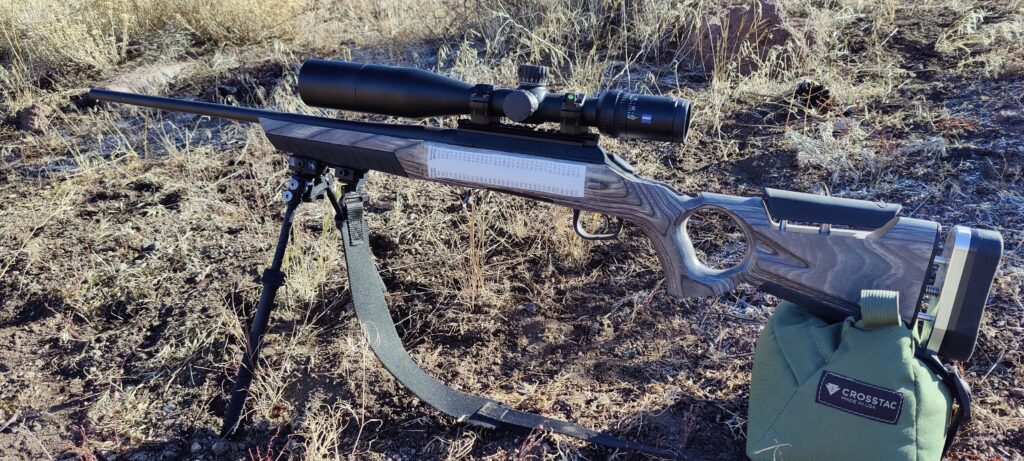
Regardless of whether you are a fan of shooting with a bipod or a tripod, an often forgotten element to setting up for a shot is supporting the rear of your gun. It wasn’t until I started using a rear support in the field while hunting that my eyes were opened to just how makeable shots were that I never thought possible in the past. Simply put, a bipod with an ultralight rear support like the Crosstac Ultralight Rear Bag or the Kestrel rear shooting support have been an absolute game changer. My effective range more than doubled once I put these tools to use (along with more range time).
17 Best Rifle Bipods for Hunting: Compared
Now that we’ve gotten some of the logistical challenges and arguments out of the way, let’s take a look at some of the options out there. Over the last 6 years, we have personally tested each and every one of these bipods during hunting trips to really get a feel for each of their pros and cons.
As you would expect, we found that none are perfect, but if you are still reading, you likely are still at least considering using a bipod for hunting. So here we go- in no particular order-the 17 best rifle bipod options we tested over the last 6+ years. Obviously, there are a TON of other options out there, but these are the ones we tested.
Spartan Precision Javelin Pro Hunt TAC Bipod
THE SHORT AND SWEET DETAILS – SPARTAN PRECISION JAVELIN PRO HUNT BIPOD
This little compact option is one of the more unique hunting bipods of the group that we’ve tested over the years for a number of reasons. First, is attaches to your rifle via the Spartan Precision MagnaSwitch magnetic attachment system. While this is an attachment system entirely unique to the Spartan Precision lineup of products, if you use the Spartan Precision system, it is a pretty sweet setup.
Even if you aren’t all in on the Spartan Precision system and want to keep your Arca setup, you can simply use the Spartan to Arca adapter to be able to use any of the Spartan Precision system products. The Javelin Pro Hunt bipod is designed to be removed from your rifle when not in use, is lightweight, and comes with multiple leg height options, as well as either twist lock or notched, spring loaded legs (the Pro Hunt Tac legs).
UNIQUE FEATURES
2 Leg Options: The Spartan Precision Javelin is offered with their Pro Hunt Tac legs, or the lighter weight Javelin Lite fixed height legs. Personally, I need a bipod to be more adjustable than the fixed height that the Javelin Lite offers, but if you are trying to shave every ounce for going deep into the backcountry, the Spartan Precision Javelin Lite is one to look at. On the other hand, the Pro Hunt Tac legs are incredibly easy to deploy by simply pushing a button. There is, however a 2.8 ounce weight penalty if you choose the Javelin Pro Hunt Tac (4.8 ounces for the Javelin Lite vs 7.6 ounces for the Javelin Pro Hunt Tac).
Magnetic Attachment: The signature feature of the Spartan Precision Javelin bipods is their ability to detach from the rifle via simply pulling them off the magnetic attachment point, and storing it in your pack, bino harness, belt holster, or pocket. This solves one of the problems listed above as a reason not to take a bipod, because you simply don’t need one attached to your gun until it’s time to take a shot. This quick-detach system makes a ton of sense, but at the same time presents a different challenge: don’t forget to grab it out of your pack if you are one to drop your pack on a stalk.
SPECS – SPARTAN PRECISION JAVELIN
- Machined 7075 hard-anodized aluminum body
- Premium carbon fiber legs
- Tungsten carbide tips with tethered synthetic boots
- Magnetic “MagnaSwitch” attachment
Reasons To Buy
- Incredibly lightweight
- Compact and no protruding parts
- Easily detachable via magnet
- Features both pan and cant
- Very solid, but does need to be “loaded” a little bit
Reasons Not To Buy
- Don’t care for the way the legs twist
- Easy to drop your pack on a stalk and leave the Javelin Bipod in your pack
- A little bit of wobble/play – needs to be “loaded”
Atlas PSR Bipod Review
THE SHORT AND SWEET DETAILS – ATLAS PSR BIPOD
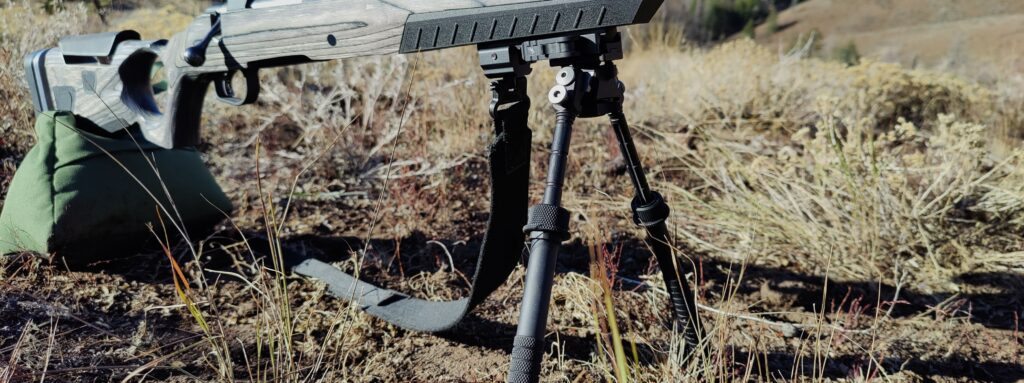
Atlas bipods have been around for a long while, and are well known for their durability and stability. They certainly aren’t the lightest on the market, but they also aren’t overly heavy. The Atlas PSR bipods are plenty light to take hunting ranging from 11.4 to 15.1 ounces, depending on the configuration. The give you multiple leg angles to maximize stability and versatility. The legs deploy quickly and easily so you won’t spend your time fiddling with twisting and adjusting legs.
The Atlas PRS bipod isn’t overly unique, but it is well built and gives you all the features you need for many shooting positions. It has limited height options, even when you add the optional 4 inch leg extensions (I always put those on when hunting and took them off for range days)
UNIQUE FEATURES
Optional Leg Extensions: I love that Atlas has the option to add an extra 4″ leg extension (or stack multiple) to get the height you need in hunting situations. They are quick and easy to remove when the time comes to head back to the range.
Many Attachment Options: Atlas offers a variety of clamp options to make sure you are set up with your rifle, including ARMS17S, Picatinny, quick detach levers, or screw on style that are more permanent.
Leg Positions: The Atlas PSR gives you 5 leg positions, however, the legs do not splay out to get you lower to the ground if needed. That’s a feature I certainly wish they offered.
SPECS –
- Machined 7075 T-6 aluminum body and legs
- Weight: 11.42 – 15.13 oz
- Pull style leg deployment
- 5 leg positions
Reasons To Buy
- Reasonably lightweight
- All Aluminum construction
- Many attachment options
- Features both pan and cant
- Optional 4″ leg extensions
- Quick, easy leg deployment
- 5 leg positions
- Very solid, durable construction
Reasons Not To Buy
- Legs do not splay out
- Moderate height adjustment
Harris Bipod Review
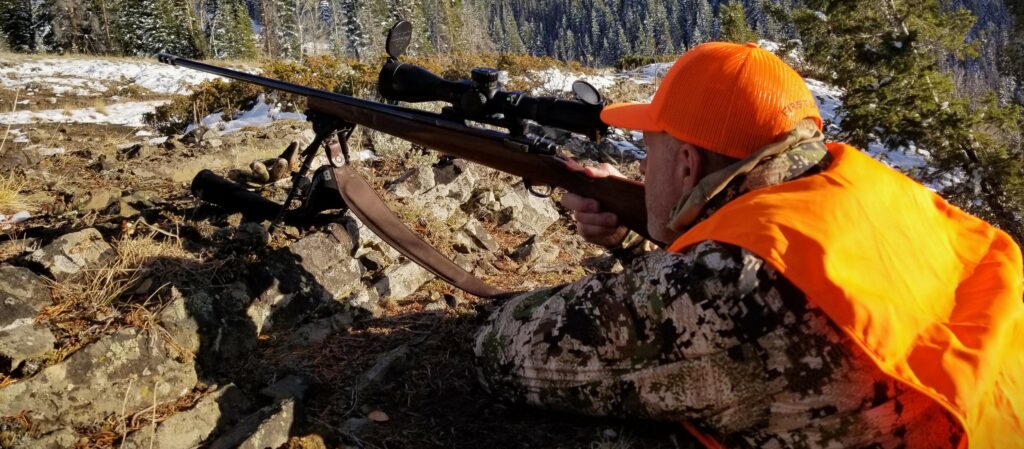
THE SHORT AND SWEET DETAILS – HARRIS 1A2-BRM BIPOD
Harris bipods have been around forever, are well known, and some of the more reasonably priced bipods on the market. That being said, they are more bulky and cumbersome than any others we’ve tested. They offer one of the most basic feature sets you can get, but still accomplish the main goal of providing stability for your shot when the time comes.
While Harris offers a wide range of bipods, the one I used was the Harris 1A2-BRM, which is one of their more basic bipods. At the time I used this bipod, I needed on that would attach to my existing sling stud, so this one fit the bill. It’s affordable and attaches easily without tools, but also doesn’t offer a pan or cant feature, which is a deal breaker for a lot of folks. The legs deploy quickly and easily, which is a great feature, but the exposed springs tend to snag on your pack or clothes, which isn’t ideal.
UNIQUE FEATURES
Extensive Models/Options: Harris bipods have way too many options to go over here, so if you want a more feature rich bipod, Harris probably has it. Most of the Harris options also have notched legs in 1 inch increments, which makes for super fast, super consistent deployment of the bipod.
Many Attachment Options: Harris offers bipods that cover a majority of the attachment options, so if you will likely be able to find one that’ll work with your rifle.
SPECS – HARRIS 1A2-BRM BIPOD
- Heat treated steel and hard alloys
- Weight: 11 oz
- Spring loaded leg deployment
- 6-9″ height adjustment
Reasons To Buy
- Best for bench rest applications
- Reasonably lightweight
- Many attachment options
- Quick, easy leg deployment
- Very solid, durable construction
Reasons Not To Buy
- Legs do not splay out
- Limited height adjustment
- Bulky & exposed springs
- No pan or cant
- 1 leg position
Magpul Standard Bipod Review
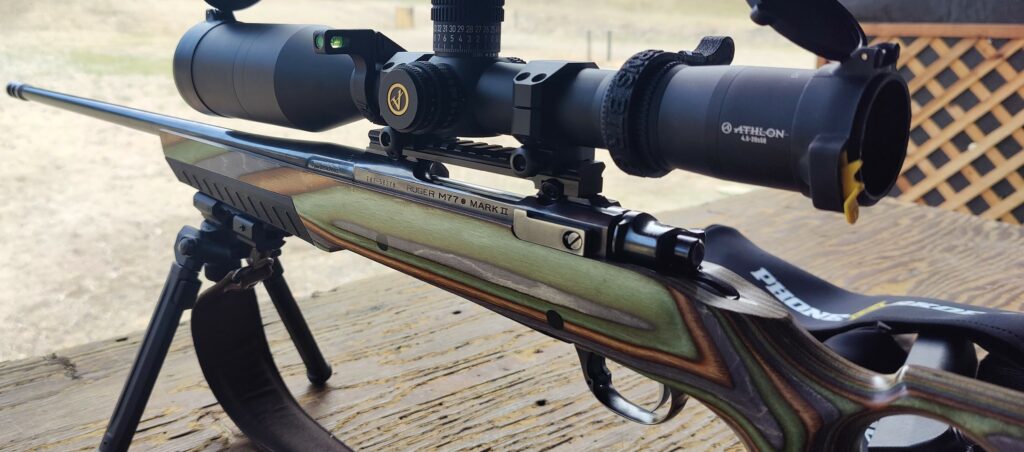
THE SHORT AND SWEET DETAILS – MAGPUL BIPOD
The Magpul bipod is a popular one, and for good reason It is lightweight at just 11 ounces, offers quick deployment, silky smooth leg adjustment, and is very affordable. It’s certainly not without its downsides though. Like the Harris, it offers just one leg position and the legs do not splay out. While you do get more adjustablilty than the Harris with a range of 6.3 – 10.3 inches, it’s still on the short side for a hunting bipod if the grass or brush might be tall. Still though, it’s definitively one to consider when you don’t want to spend a fortune.
UNIQUE FEATURES
“The Wobble”: The Magpul bipod is known for its “wobble” when deployed. You’ll notice a generous amount of “play” in the legs of the bipod, which is by design. This Magpul is meant to be “loaded”, or pushed against prior to the shot, significantly. Some people dislike that, while others love it. Either way, you’ll want to make note of that and make sure you load it for optimal performance.
Push-Button Leg Height Adjustment: One of the things I love about the Magpul bipod is how quick and easy the leg deployment is. There are no buttons to push to get the legs deployed, so it takes less than a second to be fully deployed. Once the legs are deployed, a simple push of a button allows for the easiest height adjustment of any bipod I’ve used. It’s silky smooth and fast…exactly what you want in a hunting bipod or when you are on the clock at a match.
Many Attachment Options: Magpul offers a number of attachment options, including, Picatinny, A.R.M,S-17S, and sling stud. I do wish they offered this with an ACRA-compatible clamp though and so many rifles are going that direction. I also wish the legs splayed out and there were more leg angle options, but this Magpul hits a great price point while still offering pan and cant features (some models).
SPECS – Magpul Bipod
- Mil-spec hard anodized 6061 T-6 aluminum and injection-molded polymer
- Height: 6.3 – 10.3 inches
- Weight: 11 oz
- Push button leg deployment
- 1 leg angle positions
Reasons To Buy
- Reasonably lightweight
- Durable, lightweight construction
- Many attachment options
- Features both pan and cant
- Quick, easy leg deployment
- Great price point
Reasons Not To Buy
- Legs do not splay out
- Moderate height adjustment
- Only 1 leg angle
- Some don’t like the wobble
- ARCA compatible clamp not offered
Swagger SEA 12 Bipod Review
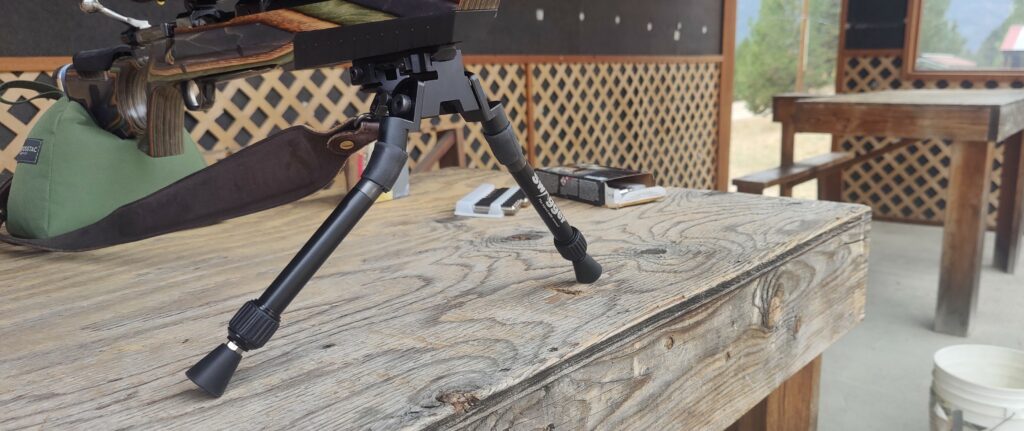
THE SHORT AND SWEET DETAILS – SWAGGER SEA 12 BIPOD
The Swagger SEA 12 bipod is one of the more unique bipods we’ve tested, simply because the Overmolded Quick Adapt HD joint makes it incredibly flexible and versatile. Because of this, the legs, once deployed, can be splayed out, straightened up, and even extended using the twist lock style extensions. It’s not overly lightweight at 13.6 oz, and has the smallest adjustment range of just 6-9 inches. That “spec” doesn’t tell the whole story though as you can utilize the flexible joint to get lower to the ground if needed.
UNIQUE FEATURES
Overmolded Quick Adapt HD Joint: The only bipod we’ve tested that offers this features, this flexibility is super useful when it comes time to make shot on uneven terrain. This flexibility also reduces it’s stability, so there’s a tradeoff.
Only One Attachment Option: Unfortunately, the only attachment option for this bipod is picatinny. While that’s certainly the most popular, it would be nice if other options were available.
SPECS – Swagger SEA 12
- Materials: Unknown
- Weight: 13.6 oz
- Twist lock leg deployment
- Unlimited leg positions
Reasons To Buy
- Unlimited leg positions/angles
- Features both pan and cant
- Quick, easy leg deployment
- Extremely versatile
Reasons Not To Buy
- On the heavy side for it’s height
- Only picatinny option
- Minimal height adjustment
- Only 1 leg angle
- No pan or cant
Swagger SFR 10 Bipod Review
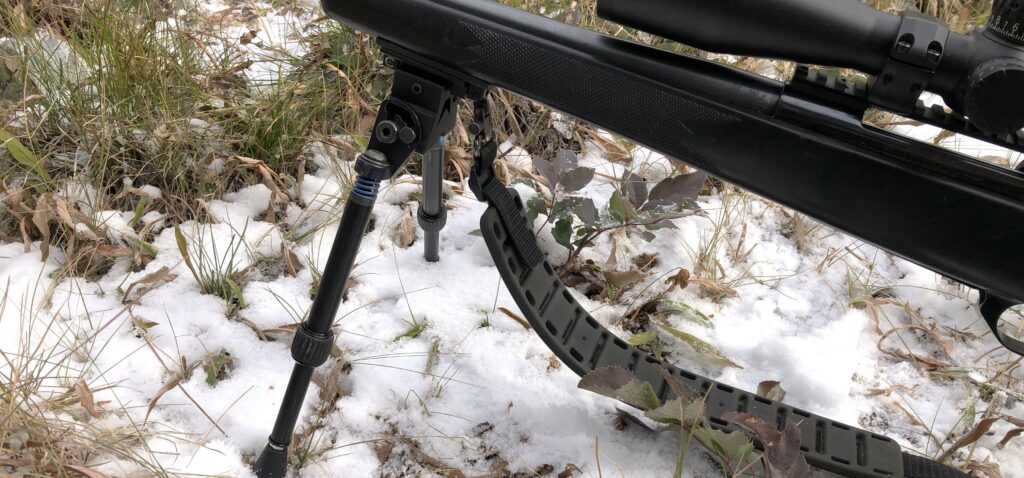
THE SHORT AND SWEET DETAILS – SWAGGER SFR 10 BIPOD
The Swagger SFR 10 bipod has an interesting spring-loaded connection point that is adjustable to give you more or less flexibility. It’s super unique in that way. You can also completely tighten down the spring to lock down the adjustable and make it operate like a traditional bipod. Other than than, its moderate height range is adequate for many hunting situations, but more range would be better suited to gain clearance over brush and grass.
The legs adjust via a twist-lock-style mechanism, giving you no set notches within the adjustment range like some bipods. That said, twist lock legs in a bipod aren’t my personal favorite as they are slightly more difficult to operate from behind the gun. The Swagger SFR 10 also does not offer pan or cant options, which further limits it’s functionality as a hunting bipod on uneven terrain.
UNIQUE FEATURES
The primary feature that is unique about the Swagger SFR 10 bipod is the adjustable flex to rigid legs, utilizing the spring-loaded tension to adjust each leg independently. To my knowledge, it’s the only bipod that offers this feature. It also offers a quick release picatinny attachment, so it’s fast and easy to remove and throw in your pack if you want.
SPECS – Swagger SR 10
- Quick disconnect lever
- Picatinny rail mount only
- 6″ – 10.5″ range
- Weight: 15.2 oz
- Twist-lock-style leg deployment
- 5 leg positions
Reasons To Buy
- Wide range of adjustment
- Adjustable spring tension
- 2 leg angle options
- Solid, durable construction
- Quick release lever
Reasons Not To Buy
- Legs do not splay out
- Moderate height adjustment range
- Picatinny only
- On the heavy side at 15.2 oz
- No pan or cant
Swagger Hunter 29/42 Bipod
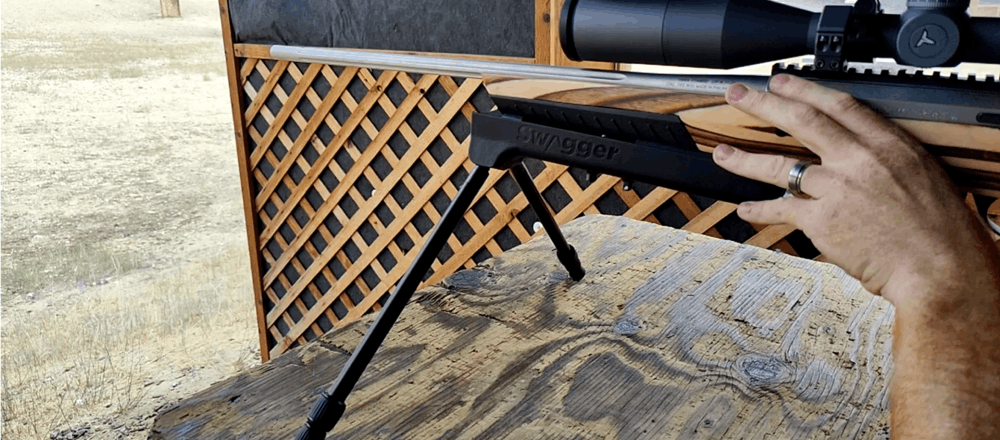
THE SHORT AND SWEET DETAILS – SWAGGER HUNTER 29/42 BIPODS
The Swagger Hunter bipod is one of the most versatile bipods we’ve tested, however, that comes with a significant weight and bulk penalty. The heaviest and bulkiest of all the bipods we’ve used, those are major deterrents for most backcountry hunters, but might not be a big deal if you spend most of your time on a side by side or 4 wheeler. The way the legs deploy and flex via the springs allow for nearly endless leg angles in all directions.
At 23 and 25 ounces, and being anything but sleek on the rifle, you are going to know this thing is on your rifle. The legs stow nicely in the body of the bipod, but let’s make no mistake about it. It’s massive on your gun. However, it also gives you enough height (29 inches or 41.25 inches depending on the model), allowing you to easily shoot from a sitting position, a feature that can make a huge difference.
UNIQUE FEATURES – SWAGGER HUNTER BIPOD
The Swagger Hunter bipods are extremely unique in the way the legs are stored, being housed in individual pockets. The legs are extremely flexible at the spring joint near the top, allowing the shooter to accomplish just about any position possible in the woods. The Swagger Hunter bipods can be attached to your rifle using the existing sling stud, M-LOK, KEYMOD, and standard rifle adapter.
The Swagger Hunter bipods also feature what they call their “Quick Adapt Technology”, which allows the shooter to lock in the legs to function like a typical bipod, or pull them out of the housing pocket and reveal a spring, allowing for extensive leg adjustment.
SPECS – Swagger Hunter 29/42
- Quick Adapt technology
- Weight: 23.6 or 25.78 oz
- Pull style leg deployment
Reasons To Buy
- Exceptionally versatile
- Many attachment options
- Quick, easy leg deployment
- Endless leg positions
Reasons Not To Buy
- Very heavy and bulky
- Stability isn’t quite as good as others
- No dedicated pan or cant
- Installation isn’t as easy as others
Magpul MOE Bipod Review
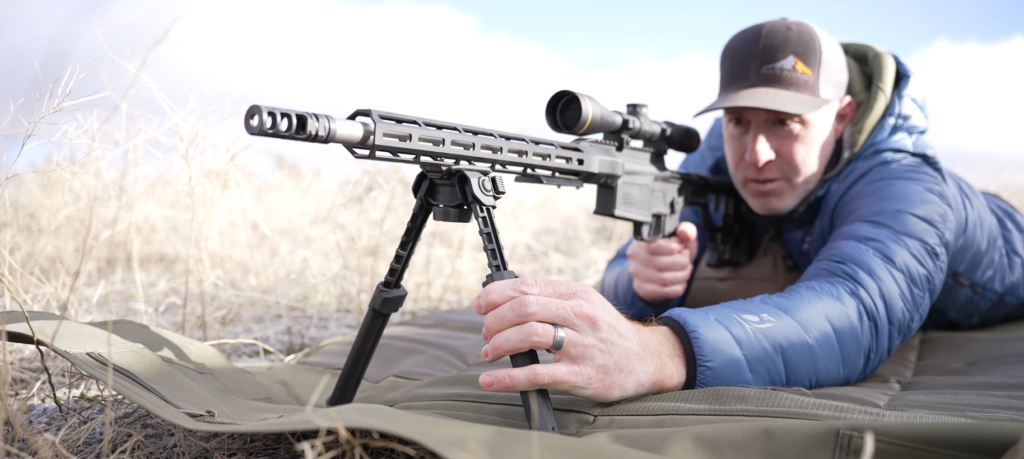
THE SHORT AND SWEET DETAILS – MAGPUL MOE BIPOD
The Magpul MOE bipod is a stripped-down offering similar to Magpuls standard bipod, but designed to save weight. At just 8 ounces it’s one of the lighter bipods we’ve tested, but not the lightest. It’s also one of the most affordable, which is very appealing. It offers a very narrow adjustment range of just 7-10 inches, so you don’t have much range with the Magpul MOE. It is buily to be attached using your existing sling stud, but adapters can be purchased for picatinny or M-LOK. A major downside with it though is that it doesn’t have pan or cant features, so it’s adjustability and versatility are limited.
UNIQUE FEATURES
This Magpul MOE bipod is frills-free, lightweight, inexpensive bipod. There’s nothing fancy about it, but it is solid, operates very smoothly, and does what it’s supposed to for a very reasonable price. It also is designed to be used with your existing sling stud, which is appealing as not many bipods are anymore. If your rifle isn’t equipped with a picatinny, ARCA, or M-LOK, this is a great option.
SPECS – MAGPUL MOE
- Polymer and steel construction
- Weight: 8 oz
- Pull style leg deployment
- Sling stud compatible
Reasons To Buy
- Very lightweight
- Polymer and steel construction
- Many attachment options
- Quick, easy leg deployment
- Sling stud compatible
- Reasonably priced
- Slim profile
Reasons Not To Buy
- Legs do not splay out
- Minimal height adjustment
- No pan or cant
Atlas CAL Bipod Review
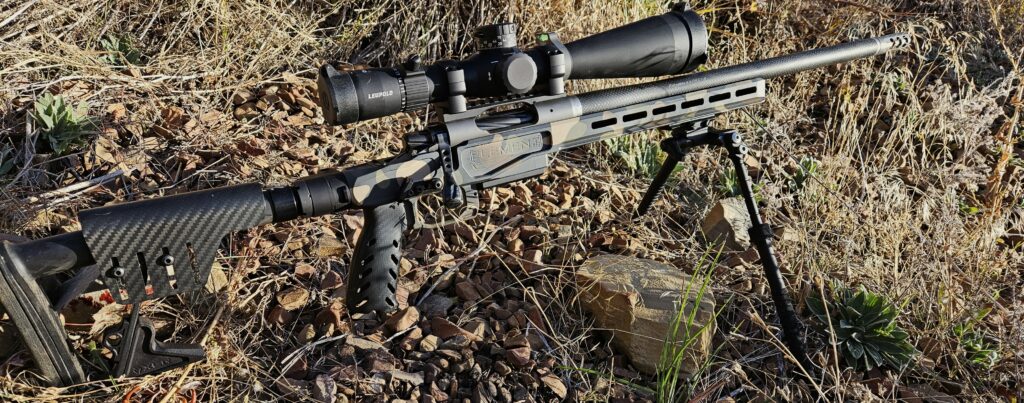
THE SHORT AND SWEET DETAILS – ATLAS CAL BIPOD
The Atlas CAL Bipod isn’t one that was designed for hunting specifically, but that’s what I used it for, and found it to be an excellent bipod for hunting. The Atlas CAL bipod offers a fairly wide range of adjustment at 4.9″ – 9″, due to it’s 45° leg angle adjustment option. It also gives you the option to add one or more 3 inch leg extensions, which is what I found useful for hunting situations. This brought the max height up to 12 inches, which was sufficient for many hunting situations.
The legs do not splay out though, and there is no pan feature. I didn’t mind not having pan because it does have cant, which is far more important to me than pan. While its not ultralight at 12.9 oz, it’s not overly heavy given how stable it is. The wider stance o the Atlas Cal offers a notably more stable platform to shoot from. The legs do not splay out though, which is a bummer.
UNIQUE FEATURES
The Atlas CAL bipod offers the signatures 5 leg angles (0,45, 90, 135 & 180 degrees), along with cant and the ability to add one or multiple 3 inch leg extensions, which makes this a super versatile bipod. The Atlas CAL is offered in many attachment options, including M-LOK, Picatinny, ARCA, ADM-170-S, or no clamp. They also offer some in quick disconnect or 2 screw clamps.
SPECS – ATLAS CAL
- Machined 7075 T-6 aluminum body and legs
- Weight: 12.9 oz
- Pull style leg deployment
- 5 leg positions
Reasons To Buy
- Reasonably lightweight
- All aluminum construction
- Many attachment options
- Features both cant
- Optional 3″ leg extensions
- Quick, easy leg deployment
- 5 leg positions
- Very solid, durable construction
Reasons Not To Buy
- Legs do not splay out
- Moderate height adjustment
- Legs don’t splay out
- On the heavier side for the height
- No pan features
Atlas V8 Bipod Review
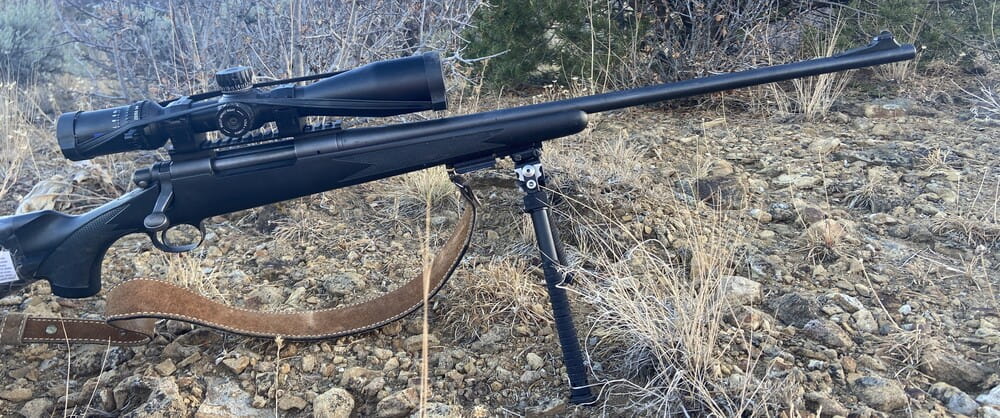
THE SHORT AND SWEET DETAILS – ATLAS V8 BIPOD
The Atlas V8 bipods are more or less a more budget-friendly version of the PSR bipods, but simply with a different material 6065 T6 vs the 7075 T6 aluminum of the PSR. Other than that, the Atlas V8 doesn’t offer non-rotating legs, aren’t quite as tall (by less than an inch), and are a little lighter weight than the PSR series. Mostly the same features you are used to with the Atlas bipods.
UNIQUE FEATURES
Just like the other 2 Atlas bipods we’ve tested, the V8 has 5 leg angles (0,45, 90, 135 & 180 degrees), multiple clamp styles, pull style quick deploy legs, and has a variety of clamp styles. You can add the optional 3″ leg extensions, but like the others, the legs do not splay out though, which is a bummer.
SPECS – ATLAS V8
- Machined 6065 T-6 aluminum body and legs
- Weight: 10.8 – 12.7 oz
- Pull style leg deployment
- 5 leg positions
Reasons To Buy
- Reasonably lightweight
- All aluminum construction
- Many attachment options
- Features both pan and cant
- Optional 3″ leg extensions
- Quick, easy leg deployment
- 5 leg positions
- Very solid, durable construction
Reasons Not To Buy
- Legs do not splay out
- Moderate height adjustment range
Gunwerks Elevate Ti Bipod Review

THE SHORT AND SWEET DETAILS – GUNWERKS ELEVATE 2.0 BIPOD
Gunwerks burst onto the bipod scene with the Elevate bipod. Shortly after that, a revised version-the Gunwerks Elevate Ti bipod came out to fix a few minor issues and increase its overall durability, and the result is one of the most versatile hunting bipods you can get. With an impressive adjustment range of 5″ – 19″, and coming in at just 12.75 ounces, you have a bipod that is perfect for the backcountry. Add in the fact that it features a push-button quick-release detach system, the legs splay out with 3 angles, and you have a bipod that changes the game for backcountry hunters.
UNIQUE FEATURES
The Gunwerks Elevate Ti bipod is loaded with unique features that set it apart from the competition. It has two leg sections for extra adjustment range, with the lower section being quick-release using a push-button, spring-loaded design, then the second section using twist-lock-style deployment.
Next you have a push-button, twist-lock quick release with a Picatinny mount so you can quickly and easily remove it from your rifle if you don’t want to leave it on at all times. A nice, easy to access tension adjustment (for the cant) is indexable and easy to use with our without gloves. The one features it doesn’t have is a pan feature, which as noted above doesn’t bother me one bit in a hunting bipod. Finally, carbon fiber legs and a titanium yoke give you extra durability all the way around.
SPECS – GUNWERKS ELEVATE TI
- Machined 7075-T6 aluminum body and legs
- Weight: 12.75 oz
- Pull style leg deployment
- 3 splay leg positions
- Noticed and twist-lock-style legs
- Carbon legs, titanium yoke
- Picatinny only currently
Reasons To Buy
- Lightweight for all you get
- Exceptional height adjustment range
- Legs splay out
- Quick release Picatinny attachment
- Fast push button leg deployment
- Carbon legs, titanium yoke
- Pan feature
- Many leg positions
- Solid, durable construction
Reasons Not To Buy
- Picatinny only
- Expensive
Backlanz Precision Long Range Bipod Review
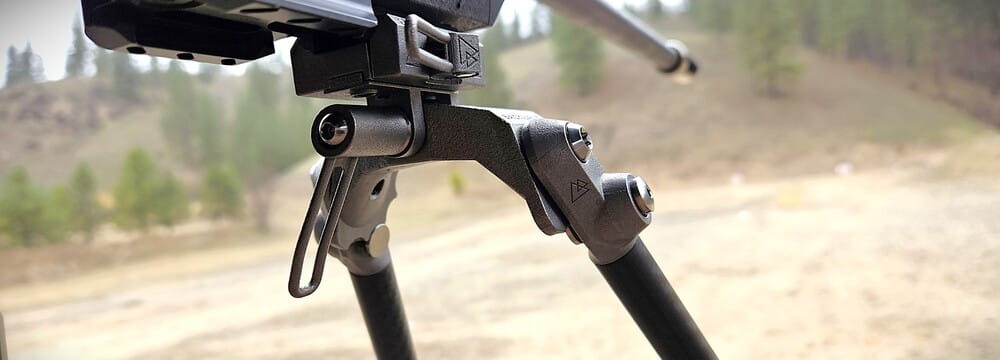
THE SHORT AND SWEET DETAILS – BACKLANZ PRECISION LONG RANGE BIPOD
Like the Alpine, the Backlanz Precision Long Range bipod is made entirely of titanium and carbon fiber, keeping the weight to a minuscule 5.78 oz with the twist-lock style legs, or 7.5 oz with the notched and spring-loaded legs. Unlike the Alpine, the legs do not splay out, so the adjustment range suffers significantly, offering a 9″ – 13″ range. Not terrible, but not nearly as adjustable as the Precision Alpine. The Backlanz Precision Long Range bipod does not offer a pan feature either, which helps improve stability.
UNIQUE FEATURES
The Backlanz Precision Long Range bipod is uniquely built entirely of titanium, with the legs made of carbon fiber. This minimizes weight with maximum stability. A nice large cant adjustment lever allows for easy adjustment for just the right tension, and you also have four leg angles in the event you are on a side hill or uneven terrain. I’ve found this feature to be extremely useful.
SPECS – BACKLANZ PRECISION LONG RANGE
- Titanium body, carbon fiber legs
- Weight: 5.78 – 7.5 oz
- Twist-lock or spring-loaded notched legs
- Lockable/adjustable cant up to 50°
- Legs do not splay
- 3 leg angles (30°, 60°, 90°)
- Picatinny, ARCA, ARMS 17S
Reasons To Buy
- Incredibly ultralight
- Titanium and carbon construction
- ARCA, Picatinny, ARMS 17S attachment options
- Features cant
- Quick, easy leg deployment
- 9 – 13 inch adjustment range
- 3 leg angles
- Solid, durable, ultralight construction
Reasons Not To Buy
- Very expensive
- Legs do not splay out
- Moderate height adjustment
Backlanz Precision Alpine Bipod Review
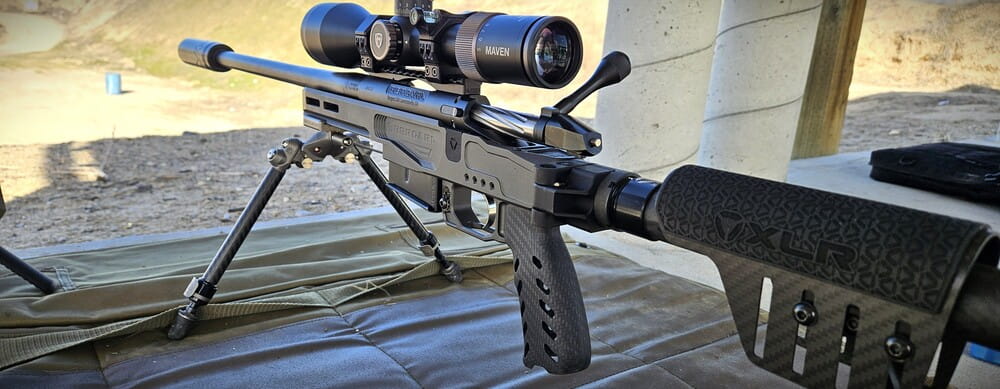
THE SHORT AND SWEET DETAILS – BACKLANZ PRECISION ALPINE BIPOD
The Backlaz Precision Alpine Bipod is an ultralight hunter’s dream. This incredible bipod is made entirely of titanium and carbon fiber, and is insanely light at just 8.29 oz (with the notched legs, 6.5 ounces with twist-lock legs). That’s just crazy with the extremely usable 5.5 – 13 inch adjustment range. Add in that the legs splay out and give you 6 splay angles and this bipod is a dream. While it’s not quite as stable as the Gunwerks Elevate Ti or the Atlas CAL, but for such a lightweight bipod, it’s quite stable.
UNIQUE FEATURES
Made entirely of carbon fiber and titanium, the Backlanz Precision Long Range Bipod is noticeably lighter than most of the competition. It is also noticeably more expensive. We all know that ultralight typically comes with a price penalty, and that is certainly the case here. That being said, this is clearly a premium, well made tripod out of New Zealand that is built specifically for the ultralight hunter. It is offered with either ARMS 17S, Picatinny, or ARCA clamp, to make sure you can easily attach it to your rifle.
It also features a quick release lever so you can take it off your rifle without any tools. The large, easy to use cant adjustment lever is fantastic and easily usable with or without gloves. Like the Gunwerks Elevate, the Atlas CAL and others, it does not offer a pan feature to maximize stability. That’s important given the ultralight nature of this bipod.
SPECS – BACKLANZ PRECISION ALPINE
- Titanium body, carbon fiberlegs
- Weight: 6.5 – 8.29 oz
- Lockable/adjustable cant up to 50°
- Twist-lock or spring-loaded notched legs
- 6 splay leg positions
- 3 leg angles (30°, 60°, 90°)
Reasons To Buy
- Incredibly ultralight
- Titanium and carbon construction
- ARCA, Picatinny, ARMS 17S attachment options
- Features cant
- Quick, easy leg deployment
- 9 – 13 inch adjustment range
- 3 leg angles
- Solid, durable, ultralight construction
Reasons Not To Buy
- Very expensive
- Not quite as stable as heavier options
- No pan
MDT Backcountry Bipod Review
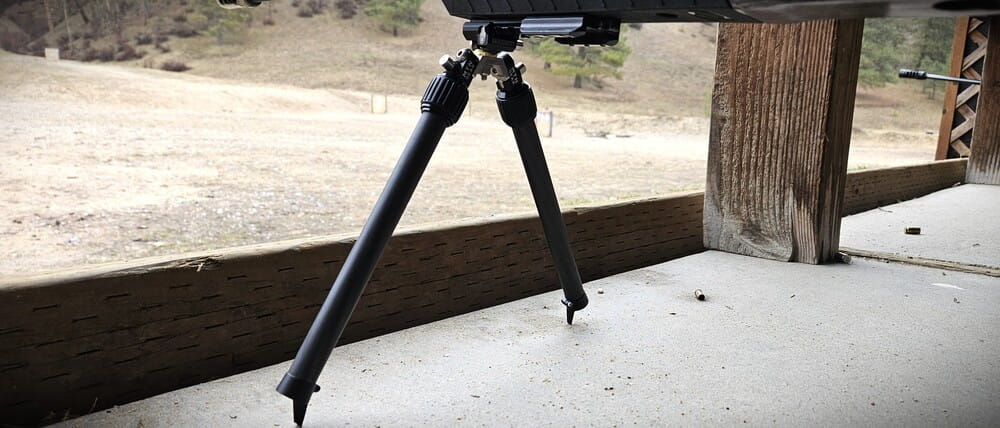
THE SHORT AND SWEET DETAILS – MDT BACKCOUNTRY BIPOD
The MDT Backcountry bipod is the lightest bipod in this review, and the lightest one we’ve ever tested at a mere 5 ounces. That hardly seems possible, but they’ve accomplished it, and done so with a fairly stable platform. While you’ll never mistake this for the most stable bipod on the market, it is absolutely plenty solid for use in the backcountry. Offering both pan and cant, an 80° cant range, and quick-disconnect push-button attachment to your Picatinny rail, this thing is built for the backcountry hunter.
It also comes with twist-lock legs, an impressive 7.5″ – 14.3″ adjustment range, and some unique spiked feet that are unlike anything else we’ve used. They work great, but are definitely best suited for the backcountry rather than the range. I wasn’t in love with how solid the attachment was, though, as I felt like it could be better and it didn’t fit well on some of my Picatinny rails.
UNIQUE FEATURES
The MDT Backcountry bipod is the lightest bipod we’ve ever tested, but still offers good stability. It only comes in a Picatinny clamp, so you are unfortunately limited to that. It does offer both pan and cant, but the legs do not splay out like its brother, the MDT Mountain bipod.
SPECS – MDT BACKCOUNTRY
- 7075 aluminum and titanium hardware, carbon fiber legs
- Weight: 5 oz
- 7.5″ – 14.3″ adjustment range
- Twist-lock-style leg deployment
- 1 leg position (90°)
- 80° cant range
Reasons To Buy
- Lightest bipod we’ve ever tested
- Titanium, aluminum and carbon construction
- Features pan and cant
- Quick, easy leg deployment
- 7.5 – 14.2 inch adjustment range
- Solid, durable, ultralight construction
- Reasonably priced
Reasons Not To Buy
- Picatinny only
- Legs do not splay out
- Only 1 leg angle
- Moderate height adjustment
- Wasn’t a perfect fit on some Picatinny rails
MDT Mountain Bipod Review
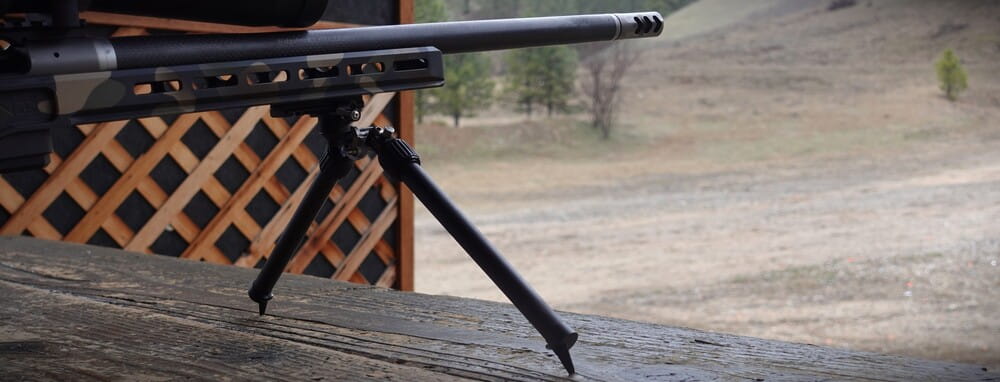
THE SHORT AND SWEET DETAILS – MDT MOUNTAIN BIPOD
The MDT Mountain bipod is much like the Backcountry, but with added features that, to me, are worth the VERY MINIMAL weight penalty. In fact, the weight difference is just 0.6 oz, and for that, you get legs that splay out with 5 angle options, a height adjustment range of 2.7″ – 15.8″, a cant range of over 180°, and both ARCA and Picatinny options. You do loose the pan feature though, so if you are fond of that, it’s a bummer. You also have either the spring-loaded quick-release attachment option (like the Backcountry), with the ability to swap that out for a more secure twist-lock mechnaism, which will more easily fit all Picatinny or ARCA rails.
UNIQUE FEATURES – MDT MOUNTAIN BIPOD
The MDT Mountain Bipod is loaded with critical features like the legs splaying out with an impressive 5 angles to choose from, an ultra-lightweight build for your backcountry rifle, and both ARCA and Picatinny attachment options. One downside is that when MDT bought the bipod from MTN Gear, the multiple leg angles went away with the MDT version. I loved the additional leg angle of the MTN Gear version.
SPECS – MDT MOUNTAIN
- 7075 aluminum and titanium hardware, carbon fiber legs
- Weight: 5.6 oz
- 2.7″ – 15.8″ adjustment range
- Twist-lock style leg deployment
- 1 leg position (90°)
- Legs splay out (5 positions)
- 180° cant range
Reasons To Buy
- 2nd lightest bipod we’ve ever tested
- Titanium, aluminum and carbon construction
- Legs splay out (5 positions)
- Features cant
- Quick, easy leg deployment
- 2.7 – 15.8 inch adjustment range
- Solid, durable, ultralight construction
Reasons Not To Buy
- Legs do not splay out
- Moderate height adjustment
- No pan feature
- On the expensive side
Gunwerks Elevate Ultra Bipod Review
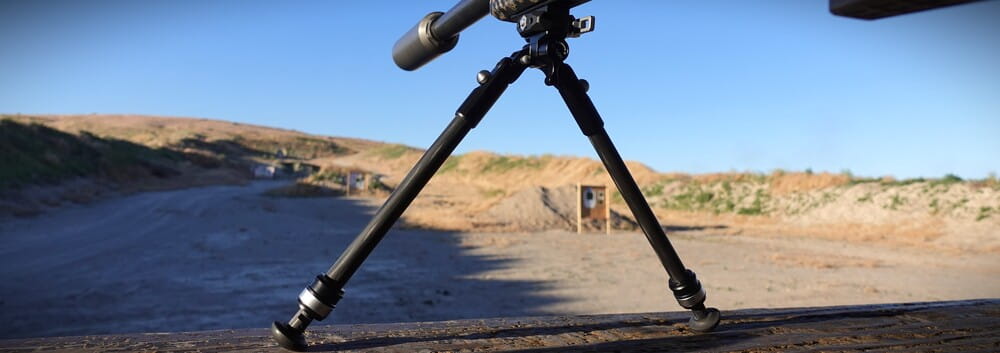
THE SHORT AND SWEET DETAILS – GUNWERKS ELEVATE ULTRA BIPOD
The Gunwerks Elevate Ultra bipod just barley snuck into this review as it just came out. Admittedly, I’ve not had nearly the time with this as all the others, but I wanted to include it with what I’ve experienced so far. Even though I haven’t taking this into the field yet on a hunt, there are a number of things that stand out as significant and noteworthy. While you don’t get quite the height of the Gunwerks Elevate Ti of the Tricer RP, it still offers an impressive height of 15″.
I found the stability to be impressive for such a lightweight bipod. Unlike others in this weight class, I have been able to really stabilize my shot without excessive bounce during and after the shot. I’d still give the stability edge to the Gunwerks Elevate Ti or the Atlas Cal or Atlas PSR, but not by a lot, and those Atlas bipods are significantly heavier without the ability to splay the legs out.
UNIQUE FEATURES
First, this is an ultralight, 8oz bipod that offers both picatinny and arca clamps, both of which are quick release, making this a bipod that don’t have to live on your rifle when not in use if you don’t want it to. Additionally, unlike most ultralight bipods, the spring loaded leg extension (just like the Gunwerks Elevate Ti bipod) make for super quick and easy adjustments when you are behind the gun. The quick deploy legs (just pull them down into position…no buttons to push or levers to pull), take all of a second to deploy. When that buck or bull is moving into the timber, that mattes.
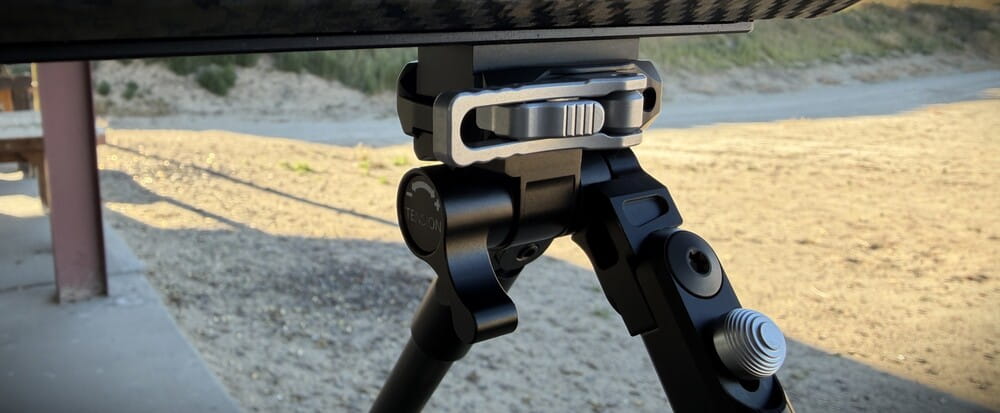
Additionally, the quick release lever locks into place so it doesn’t accidentally fall off your rifle (like I had happen with the Elevate Ti when the release button was accidentally pushed). This design is fast and easy to use, and a far superior attachment mechanism vs the Elevate Ti in my humble opinion.
SPECS – GUNWERKS ELEVATE ULTRA BIPOD
- Aluminum body, titanium yoke components, carbon fiber legs
- Weight: 8 oz
- 3″ – 15″ height range
- No pan feature
- Spring loaded, quick deploy legs
- 1 leg angle position
- Legs splay out – 4 positions
- ARCA or Picatinny clamps, ARMS-17 compatible
Reasons To Buy
- Extremely lightweight
- Aluminum, titanium and carbon construction
- Legs splay out (4 leg angle positions)
- Multiple attachment options
- Cant
- Spring loaded leg extensions
- Quick deploy legs
- Solid, durable construction
- Very stable for a lightweight bipod
- Low profile on your rifle
Reasons Not To Buy
- Expensive
- Lesser height range than the Elevate Ti
Tricer RP Bipod Review
THE SHORT AND SWEET DETAILS – TRICER RP BIPOD
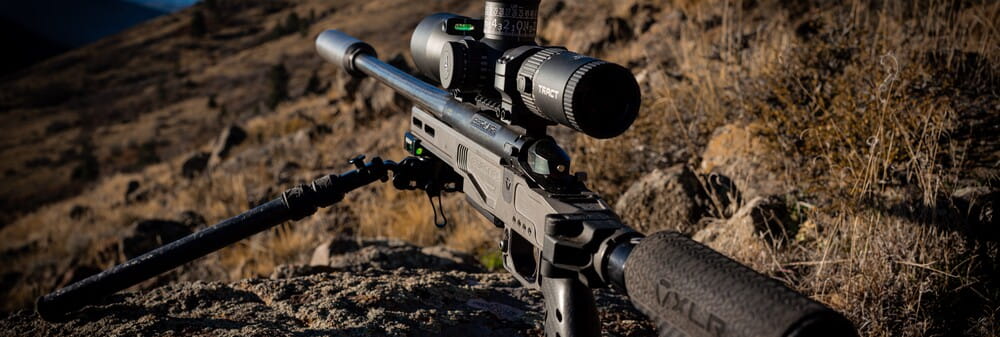
Last, but certainly not least, the Tricer RP bipod got its workout last season. It is newer to the field, but it brings the most versatility of any bipod we’ve ever used. While it’s not the lightest of the bunch by a long shot, it is by far the most versatile. Offering the most impressive adjustment range of all the bipods we’ve tested with a max range of 30 inches, while the legs being able to splay out allow for low-to-the-ground prone shots as well.
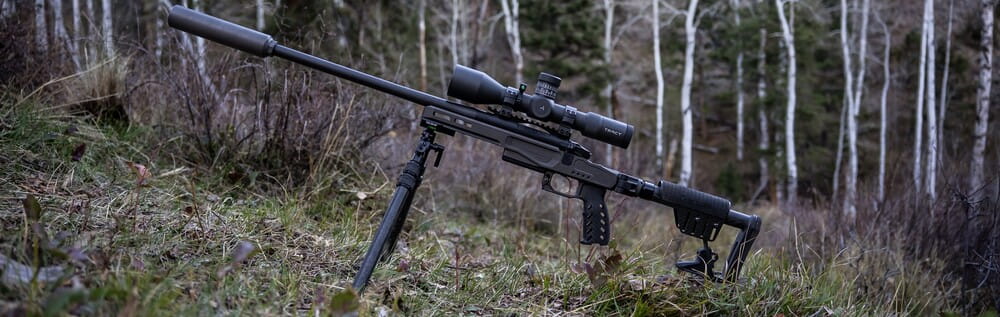
On top of that, it comes with a second shorter set of legs for range shooting, as well as Picatinny, ARCA, and sling stud attachment options at no extra cost. It really is the complete package. While I’m still not in love with the reverse-threaded twist-lock style leg deployment, the versatility is more than enough to overcome that preference.
UNIQUE FEATURES
This Tricer RP bipod is packed with unique features such as the legs splaying out, as well as four leg angle positions, an extra set of shorter legs for range days, and a massive adjustment range from prone shooting to 30 inch height for sitting and shooting. You also get a quick-release lever clamp in both Picatinny and ARCA so you aren’t committed to one or -he other, along with a sling stud adapter for your more traditional style attachment. It also comes with both spiked and rubber feet.
USE THE CODE “BACKWOODS” FOR 10% OFF YOUR TRICER ORDER
SPECS – TRICER RP
- Aluminum body and carbon fiber legs
- Weight: 10.58 – 14.25 oz
- 30-inch max height, down to prone shooting
- Pan-lock ball head
- Twist-lock style leg deployment
- 2 leg angle positions (45° & 90°)
- Legs splay out (4 positions)
- ARCA, Picatinny, sling stud attachment
Reasons To Buy
- Reasonably lightweight for what it is
- Aluminum and carbon construction
- Legs splay out (4 leg angle positions)
- Many attachment options
- Features ball head adjustability
- Pan lockout
- Extensive accessories included
- Solid, durable construction
Reasons Not To Buy
- Total weight on the heavy side
- Leg deployment not quite as easy as some
- A little bulky on your rifle
Our Picks – Best Bipod For Hunting
Best Ultralight Hunting Bipod
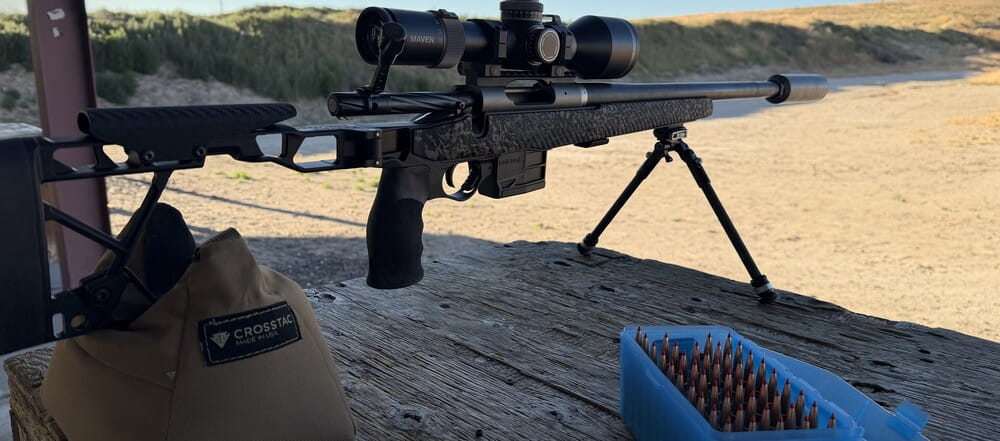
Gunwerks Elevate Ultra
If ultralight is your primary objective, it’s tough to beat the weight and feature set of the new Gunwerks Elevate Ultra bipod. While it’s not quite as light as the MDT Mountain or Backlanz Precision Alpine, I preferred its overall combination of stability, weight, functionality and adjustability. However, if you want to save another couple of ounces, go with the MDT Mountain or the Backlanz Precision Alpine.
Runners Up: Backlanz Precision Alpine & MDT Mountain Bipod
Most Versatile Rifle Bipod
Tricer RP
This one was fairly easy as nothing else other than the Gunwerks Elevate Ti even came close. The extra height of the Tricer RP, extra attachment options, and extra leg options give the Tricer RP the win here, although not without a bit of a weight penalty.
Runner Up: Gunwerks Elevate Ti
USE THE CODE “BACKWOODS” FOR 10% YOUR ORDER
Best Combination of Features, Weight & Stability
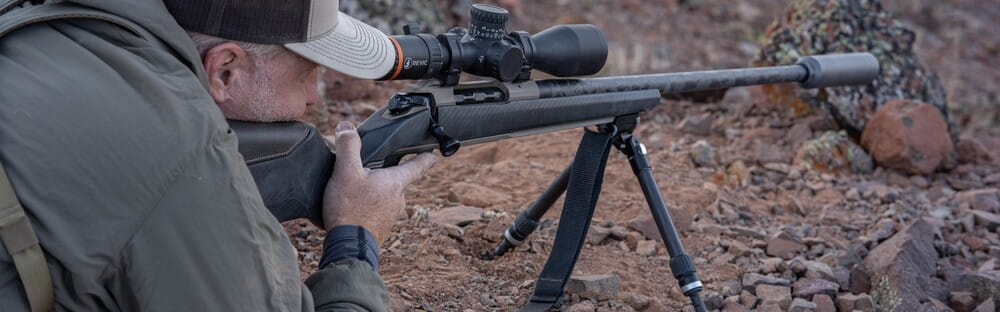
Gunwerks Elevate Ti
The Gunwerks Elevate Ti is one my favorite bipods I’ve ever used. I do wish it had slightly more height like the Tricer RP, and offered an ARCA attachment option, but nonetheless, it’s sleek, lightweight, and super adjustable, not to mention absolutely rock solid.
Runner Up: Tricer RP
Overall Best Hunting Bipod
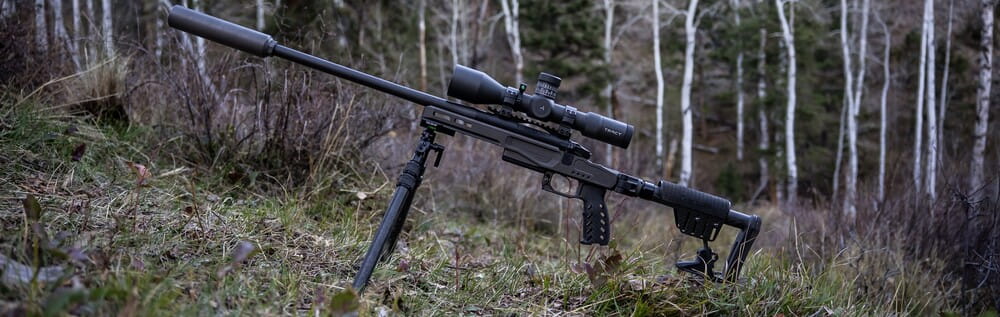
Tricer RP
This one was super tough, but the Tricer RP ever so slightly edged out the Gunwerks Elevate Ti. Not because it’s better built…I think the Gunwerks is better built and more stable, but because of the added adjustment range, more attachment options, and overall usability edge in the field. Don’t get me wrong, I still grab the Gunwerks Elevate Ti all the time, but I can’t ignore the extra shot opportunities I’ve gotten with the Tricer RP that I wouldn’t otherwise have had.
Runner Up: Gunwerks Elevate Ti
USE THE CODE “BACKWOODS” FOR 10% YOUR ORDER
Conclusion – Best Bipod For Hunting
At the end of the day, many things come into play when making your selection, but what matters most when selecting the best rifle bipod is versatility, adjustability, weight, and it’s ability to allow me to take advantage of the shot opportunities I am presented with in the field. That means more tags notched and more freezers filled. Thankfully, there are so many great options that you will likely be able to find the perfect fit for your hunting style and use case.
Subscribe to Backwoods Pursuit to get Your FREE Backcountry Gear Worksheet!!!
Dial in your gear list, calculate your pack weight, and lighten up your pack with this handy tool!