

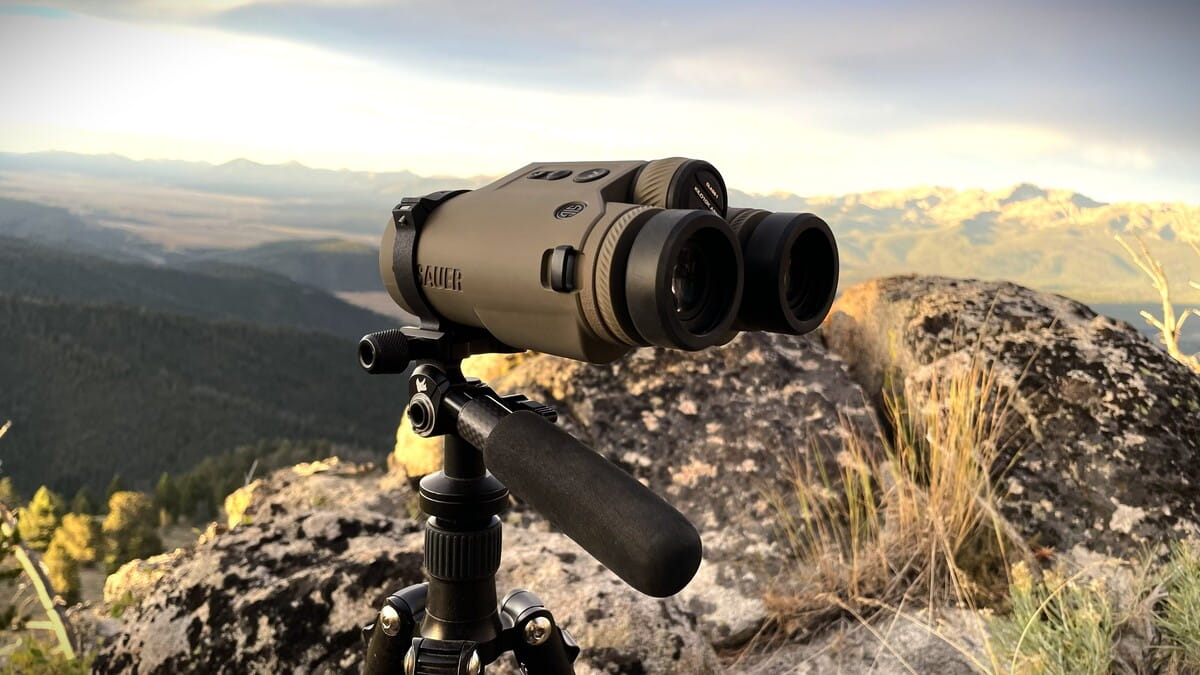
You’ve been glassing for hours on end. Maybe days on end. You finally catch a glimpse of your target buck working his way through a small opening. You put down your binoculars, pull up your handheld rangefinder, and low and behold…where did he go? You frantically search through the monocular’s narrow field of view, growing more anxious by the minute. Did he already pass through that shooting lane? That scenario is what prompted this Sig Kilo 10K Gen 2 review.
Gone are the days of fumbling through that critical transition. With rangefinding binoculars now readily available, you can quickly hit the range button and not only know the distance with certainty, but have a ballistic solution at your fingertips.
A few years ago, we performed an exhaustive review of Sig Sauer’s original (Gen I) KILO10K Rangefinding Binoculars. While the rangefinder performance of those binoculars was impressive, the optical performance left something to be desired. Sig took that user feedback into consideration and overhauled the optical system to produce the Sig KILO10K-ABS HD Gen II Rangefinding Binocular. I was beyond excited to put it to the test and see if the improvements were significant.
How It Was Tested: Sig Kilo 10K Gen 2 Review
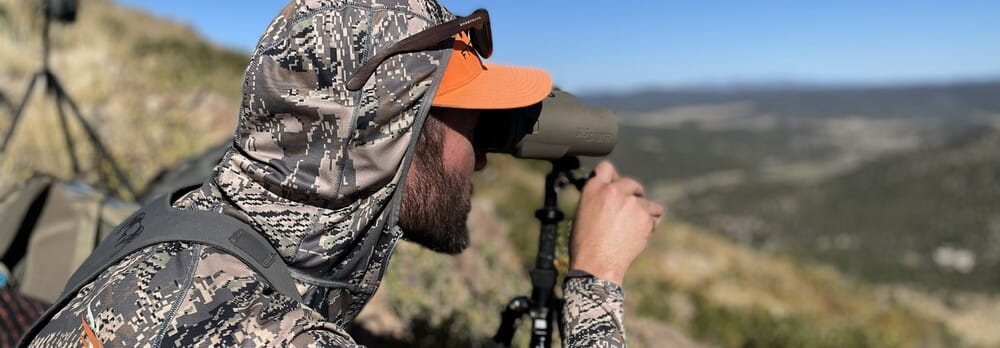
I had plenty of range sessions, scouting trips, and a full slate of hunts planned for the next couple seasons, so opportunities were ample to put this set of binoculars through the paces. I was excited to see how the Sig KILO10K Gen 2 capabilities could enhance my shooting experience and effectiveness in the field.
The Binocular Specs: Sig Kilo 10K Gen 2 Rangefinding Binoculars
First up in this Sig Kilo 10K Gen 2 review let’s look at the specs before we dive into performance details.
| Feature | Sig Kilo 10K Gen 2 Rangefinder Binos |
|---|---|
| Weight | 32oz |
| Dimensions | 5.7” x 5” x 2.5” (L x W x H) |
| Armor Coating | Rubber Armour |
| Eye Relief | 18mm |
| Eye Cups | 4 Position Twist-up |
| Diopter/Reticle Focus | Non-Locking |
| Tripod Threaded | Yes |
| Field of View | 6.1º (320 feet at 1,000 yds) |
| Max Range | Deer: 3,000y / Tree: 4,000y / Reflective: 10,000y |
| Applied Ballistics | Yes |
| Drop Waypoint | Yes |
| Bluetooth Connectivity | Yes |
| Archery Mode | Yes |
| Tripod Adaptable | Yes – Threaded |
| Waterproof | Yes – IPX-4 |
Optical Performance: Sig Kilo 10K Gen 2 Review
Rangefinding binoculars combine the features of two previously separate pieces of your kit, so I find it helpful to describe their performance independently. Keep in mind that rangefinding binoculars have to utilize additional lens coatings in order to provide the digital display. These coatings tend to slightly degrade the image, so it should be expected that some optical performance will be sacrificed to provide integrated rangefinder functionality.
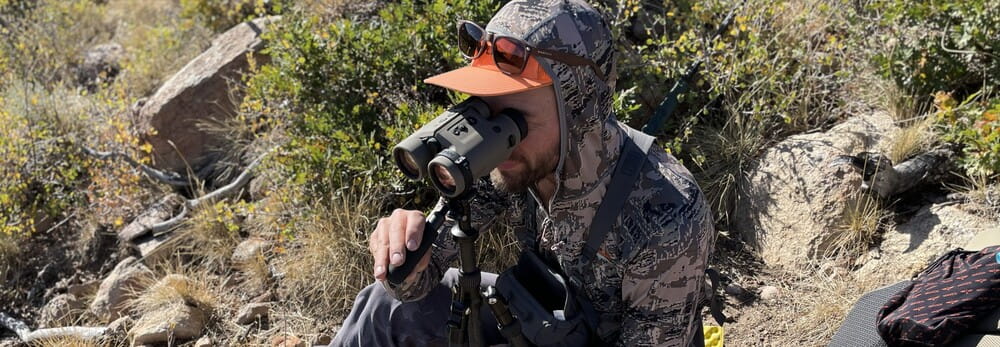
The importance of optical performance may depend on your primary use case. I’m a hunter first and shooter second, so the binoculars on my chest need to be well equipped to glass for extended periods of time. If you are a competitive shooter, then rangefinder performance may trump optics because your primary mission is generating an accurate ballistic solution.
Make sure to check out our other gear reviews and the Backwoods Pursuit YouTube Channel to help you decide what gear will help you stay out in the field longer!
Our takeaway on the Sig Gen I 10K binoculars was that the optical performance was adequate for most hunting scenarios but not outstanding. One of the biggest knocks was that the image had a noticeable blue tint which was distracting and hampered low-light performance. Was Sig able to address these limitations in the Gen IIs?
Color and Low-Light Performance: Sig Kilo 10K Gen 2 Review
Sig Sauer completely redesigned the optical system for these Gen II binoculars to improve color accuracy and low-light performance by a reported 95%. I don’t have a way to verify that value, but I can confidently state that the blue tint has been eliminated. The binoculars now have a warmer hue that is more consistent with the rest of their lineup and competitor offerings. Whereas the Gen I blue tint was off-putting, I found the Gen II tint to be very neutral even during extended glassing sessions.

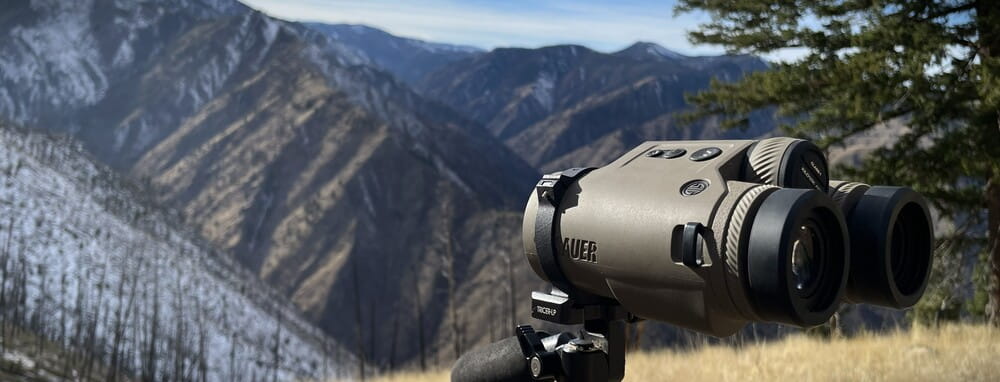
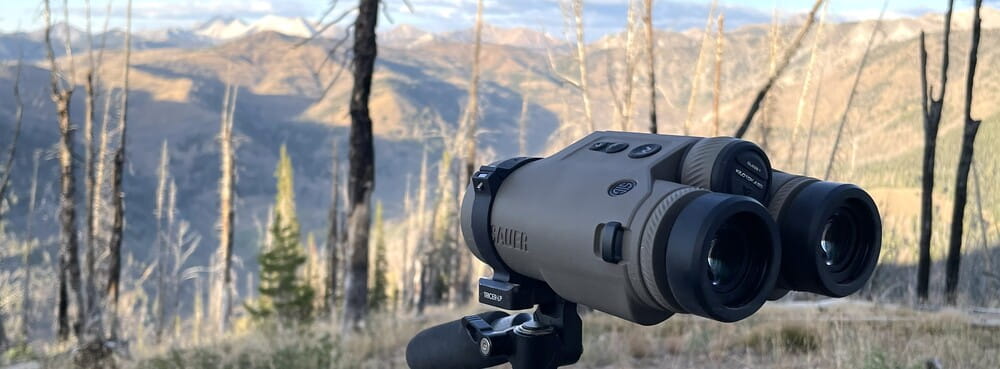
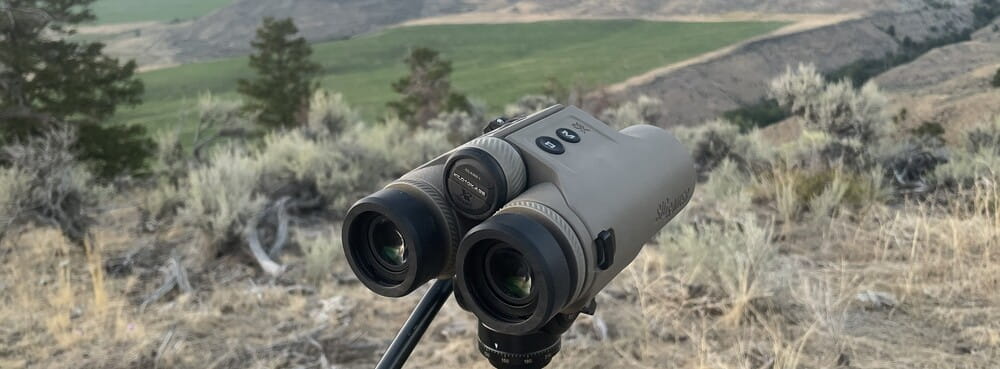
Improving color fidelity also directly improved low-light performance. The blue tint of the previous generation gave the perception (and possible reality) of less light transmitted to the eye, which was especially challenging during dawn and dusk hours when animals are often most active. Now, the Gen II KILO10K binoculars have corrected that issue and I was able to effectively glass during all legal shooting hours.
For comparison, my go-to binoculars over the past decade have been Swarovski SLCs. I feel the color fidelity of the SLCs may be slightly more true than the Sig 10K Gen 2 binoculars, but there is not a substantial enough difference to my eyes to feel that the Sigs put me at a significant disadvantage.
Edge-to-Edge Clarity: Sig Kilo 10K Gen 2 Review
When looking through optics, our eyes tend to gravitate to the center of the image, which is fortunate because that’s where an optical system shines. However, for those of us that do the majority of our glassing from stationary positions with the binoculars mounted to a tripod, it is beneficial for the full field of view to be as clear as possible.
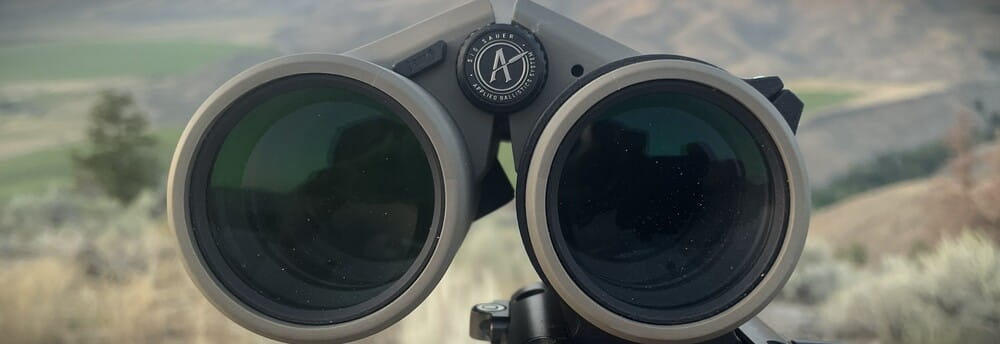
Think about it: as you grid a hillside, you pan the binoculars to a new position, let the image settle, and then look for motion, patterns, or other indicators of your intended quarry. It is advantageous for the entire field of view to be crisp and usable so you don’t have to move the binoculars any more than needed, and so you don’t overlook some critical detail.
With the Sig KILO10K-ABS HD Gen II Rangefinding Binoculars, I feel that clarity begins to suffer in roughly the outer 20% of the image. This is pretty consistent with the Gen I version and other competitor rangefinding binoculars. If I again compare them to the Swarovski NL Pures, the NL Pures definitely have a leg up in edge-to-edge clarity. However, this is to be expected from alpha glass, and the edge-to-edge clarity of the KILO10Ks is still adequate to effectively glass in field situations.
Rangefinder Features and Performance: Sig 10K Gen 2
Sig Sauer’s electro-optics are second to none, and the rangefinder performance in the Gen I binos was excellent. We were curious to see what enhancements they would incorporate into the KILO10K-ABS HD Gen II Rangefinding Binoculars to take them to the next level.
RANGING CAPABILITIES AND MODES: Sig Kilo 10K Gen 2 Review
Folks are going to want to know how far this rangefinder acquires targets and how quickly it returns results. The truth is that ranging distance depends not only on how powerful the laser is, but also on atmospheric conditions, angle, and reflectivity of the target.
The Sig KILO10K incorporates Sig Sauer’s Gen II Lightwave Digital Signal Processing (DSP) Ranging Engine, which includes small enhancements to improve ranging distance and sensitivity. Sig publishes three target-dependent ranging distances for the KILO10K-ABS HD Gen II Rangefinding Binoculars, with 3,000 yards for a deer-like target being the most relevant for hunters.
I verified this value in the field and found that with my binoculars, I could pick up animals or generic hillsides almost every time out to roughly 3,200 yards. That’s basically two miles. I think the maximum return I acquired from an offhand position was around 3,500 yards, and most returns were nearly instantaneous.
For the user interested in stretching that distance even farther, the Gen II binoculars include an Extended Range (XR) mode. This mode increases the range samples by a factor of four, which improves remote target detection at extreme distances and is intended for use when the rangefinder is tripod-mounted. By ranging from a tripod or focusing on more reflective targets, a user could increase the max range substantially (reported at up to 10,000 yards for a reflective target).
That said, the KILO10K’s basic ranging capabilities far exceed any realistic need for a hunting shot, and that two-mile capability allowed me to range distant landmarks that could be used to plan a stalk and close the distance.
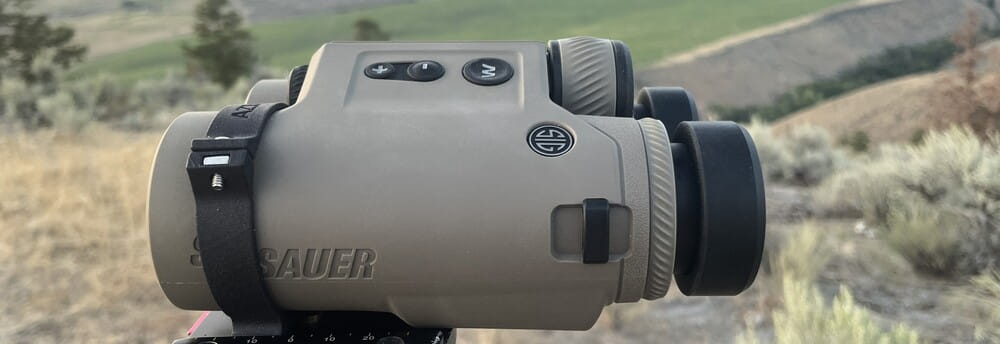
Other target modes include First (closest target), Last (farthest target, in case of brush or other obstacles), Best (strongest signal), and Fog (filters out false readings). I generally found myself leaving the rangefinder on Best and was happy with its performance in varied conditions, but it is nice to know you have other modes available.
ENVIRONMENTAL SENSORS AND COMPASS: Sig Kilo 10k Gen 2 Review
The Sig KILO10K-ABS HD Gen II Rangefinding Binoculars have onboard environmental sensors that measure temperature, pressure, humidity, shot angle (inclinometer), and orientation (through a digital compass) to provide precise inputs for ballistic calculations.
In the past, I have used handheld rangefinders that allowed you to manually input temperature and elevation (converted to pressure) to generate a ballistic solution, but you are always approximating those values in advance or trying to enter them into a calculator in the heat of the moment. The KILO10K’s onboard sensors simplify the process and enhance the accuracy of those inputs immensely.
WIND IMPUTE: Sig Kilo 10K Gen 2 Review
These Sig Kilo 10K Gen II binoculars have incorporated buttons specifically for wind. In the previous generation, you had to navigate through menus to add or change wind speed or direction. Now, a large “W” button on the top left side of the binoculars lets you enter and navigate through the wind controls, and smaller “+” and “-” buttons allow you to change wind speed and direction.
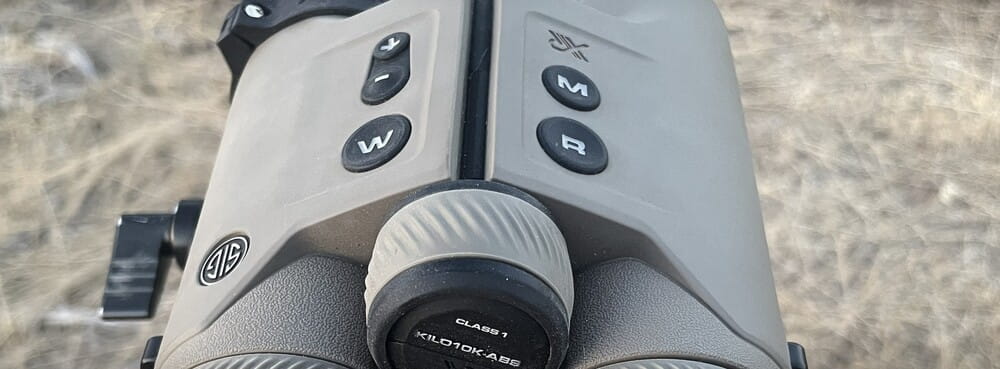
This change allows the user to input fluctuating wind conditions much quicker, and Sig Sauer should be commended for listening to user feedback on this issue.
BALLISTIC SOLUTIONS: Sig Kilo 10k Gen 2 Review
The Gen II Sig KILO10K binoculars not only have superior rangefinding ability, but they are equipped with an industry-leading ballistics calculator. Sig Sauer embedded the Applied Ballistics (AB) Elite calculator in these binos, which comes with the complete AB bullet database and custom drag curves developed from their own testing.
The ballistic coefficients in the AB library are often lower than the inflated ballistic coefficients advertised by many manufacturers. This means that your calculated hold will likely be closer to reality and you will spend less time calibrating your inputs.
So the KILO10K-ABS HD Gen II Rangefinding Binoculars can obtain a range, have onboard environmental sensors, allow you to input wind, and have an embedded ballistics calculator—but how do you input parameters from your specific rifle and load?
Sig Sauer utilizes their Ballistic Data Xchange (BDX) system to send data from an app on your phone via Bluetooth to your binoculars. The free BDX app (which contains the AB bullet library referenced above) allows you to configure up to 30 custom bullet profiles to cover all your weapons and load combinations. You then select a single profile to be active and sync it to the binoculars. Once synced, the next time you range an object, it will return not only the distance to the target but also the ballistic solution in your choice of units (MOA or MRAD/MILs).
There is also the opportunity to send the ballistic solution to a Sig Sauer BDX-enabled scope, which will adjust and illuminate the holdover dot (no dialing required). I don’t own one of those scopes, and they are not legal in all states, but the technology may be beneficial for some users.
Display: Sig Kilo 10K Gen 2 Review
The Sig KILO10K-ABS HD Gen II Rangefinding Binoculars generate a lot of data with their rangefinder and ballistic calculator functions. So how does this information get communicated to the user?
The display inside the binocular when the range mode is set to BDX Elite includes the following data fields (top to bottom):
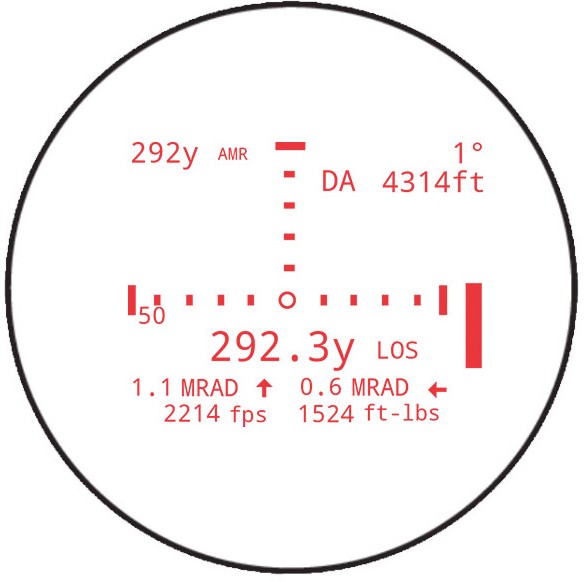
- Angle Modified Range (AMR)
- Angle/Inclination
- Density Altitude
- Reticle (circle, duplex, or square, all with or without the grid)
- Line of Sight (LOS) distance
- Ballistic Solution (elevation and windage in MOA or MRAD/MILs)
- Impact velocity
- Impact energy
There are other range modes that will display different information:
- BDX External can be used to connect to external devices such as a Kestrel or Garmin. In this mode, the LOS range and angle is sent to the external device where the ballistic solution is calculated, and then elevation and wind hold information is transmitted back to the binoculars for display.
- AMR is the angle modified range and provides the equivalent horizontal distance to the target. The AMR distance will be displayed in the center of the display below the reticle.
- LOS is the line of sight range to a target independent of angle. LOS will be displayed in the center of the display below the reticle and angle will be displayed in the upper right of the display.
- Archery utilizes your arrow speed to provide precise angle compensation and accurate ranges for extreme angles and distances.
Waypoint Generation: Sig Kilo 10K Gen 2 Review
The Sig KILO10K-ABS HD Gen II Rangefinding Binoculars are capable of integrating with both the OnX and BaseMap apps to create waypoints. When you have the rangefinder mode enabled in the app, the app will drop a waypoint where you range an object. This feature can be especially helpful when you’ve taken a shot and want a precise location to speed recovery, or when you’re planning a stalk and need to drop out of sight to close the distance.
I have not used this feature extensively but look forward to exploring it further in the future. I’ve heard though, that accuracy of the dropped waypoint can be challenging as this technology is still relatively new.
Experience and Impressions: Sig Kilo 10K Gen 2 Review
First and foremost, I rely heavily on binoculars for extended glassing on most of my hunts. It’s critical that my binoculars are comfortable to use and clear enough to allow me to methodically pick apart patches of cover looking for an animal.
The Sig KILO10K-ABS HD Gen II glass quality was a noticeable step up from the Gen I KILO10K and was serviceable for all-day glassing, but let’s be clear—you will not be confusing it with top-tier alpha glass. I did not experience significant eye fatigue, although the ergonomics of the eye cups of the Sig Kilo 10K Gen 2 binoculars do not fit my face shape extremely well. I sometimes found myself fighting to get them in the right position to maximize the field of view. In contrast, with NL Pures, I rarely struggle with that aspect.
The body features a tan textured rubber coating that is aesthetically pleasing, provides protection, and offers a reliable grip. Although the binoculars come threaded for a center-mount tripod adapter, I have grown to love low-profile mounts like the Aziak Bino Clamp that have an integrated Arca-Swiss dovetail to connect directly to my tripod head, and the 10K Gen IIs worked great with that setup.
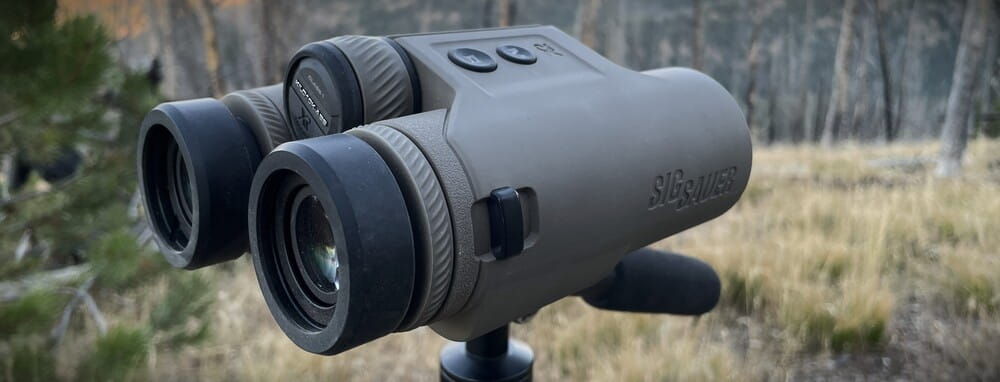
After doing my testing for this Sig Kilo 10K Gen 2 review, the star of the show in these binoculars was the rangefinder and onboard ballistic calculator. Ranging returns were ultra quick and consistent well beyond any distance I would consider shooting. I found the app to be intuitive and easy to use. The pairing and syncing functions worked well, and it was easy to swap between weapons.
I have now utilized these binoculars to help harvest a handful of mule and whitetail deer on western hunts over the past two seasons, and being able to obtain an on-demand ballistic solution specific to my location using information from the onboard environmental sensors was invaluable. I have no doubt that the speed and efficiency gained with this system will lead to more shot opportunities in the future.
Conclusion: Sig Kilo 10K Gen 2 Review
Strengths
- One of the best rangefinders on the market
- Optical performance improved over Gen I (blue tint removed)
- Dedicated buttons to easily change wind speed and direction inputs
- Phone app and Applied Ballistics bullet library and solver worked seamlessly
Weaknesses
- Optical quality is not elite
- Heavier and more cumbersome than conventional binoculars
- Eye cup ergonomics aren’t great
If you’re looking to get into the rangefinding binocular game, the Sig KILO10K-ABS HD Gen II rangefinding binoculars warrant serious consideration. You just need to recognize up front that rangefinding binoculars are all about tradeoffs. You gain the ability to obtain a range to your target and a ballistic solution for your weapon, but the extra lens coatings needed for the display compromise optical integrity.
You might think you can work around that issue by going with one of the alpha glass manufacturers, but for now, their rangefinders and ballistic solvers are not as functional. If you’re a competition shooter who prioritizes rangefinder performance, the rangefinder in the KILO10K Gen IIs is world class and they may be perfect for you.
If you’re a hunter whose primary focus is glassing, you may be left wanting a little better optical performance, but as discussed above, that’s the case with most rangefinding binoculars. Overall, the KILO10K-ABS HD Gen II Rangefinding Binoculars checked the major boxes I was looking for, and I wouldn’t hesitate to recommend them.
Subscribe to Backwoods Pursuit to get Your FREE Backcountry Gear Worksheet!!!
Dial in your gear list, calculate your pack weight, and lighten up your pack with this handy tool!